Heart Circle 1 Earring Charm STL File: Evaluating Versatility and Print Quality for Custom Jewelry
Selecting the right digital asset for 3D printed jewelry requires balancing aesthetic appeal with technical feasibility. The Heart Circle 1 Earring Charm STL File represents a specific category of digital findings designed to bridge the gap between vintage ornamentation and modern manufacturing. Unlike generic heart shapes often found in free repositories, this design focuses on structural integrity across multiple scales, making it suitable for applications ranging from delicate earrings to substantial wall hangings. For makers and small business owners evaluating their options, understanding the distinct characteristics of this file pack is essential for determining if it aligns with current production capabilities and creative goals.
Distinguishing Features Against Generic Alternatives
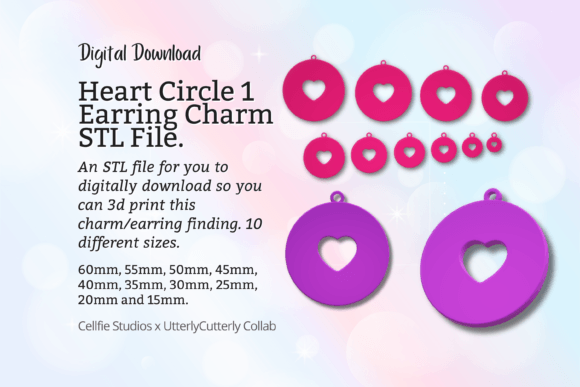
When comparing the Heart Circle 1 Earring Charm STL File to standard heart models, the primary differentiator is the intentional scaling strategy. Many open-source or basic commercial STL files are modeled at a single resolution. When users attempt to scale these down for earrings or up for ornaments, geometry often fails; walls become too thin to print reliably, or surface details become muddy. This specific digital download addresses that limitation by providing ten discrete size variations rather than a single scalable mesh.
The included sizes—60mm, 55mm, 50mm, 45mm, 40mm, 35mm, 30mm, 25mm, 20mm, and 15mm—are pre-optimized. It is important to note that these measurements refer to the charm body itself and do not include the loop hole. This distinction matters for precision work. If you are designing a necklace where the total drop length must be exact, accounting for the separate loop geometry prevents sizing errors. In contrast, generic alternatives often force designers to manually repair topology after resizing, adding hours of CAD work to what should be a simple printing task. The "vintage yet modern" aesthetic also offers a middle ground; it avoids the overly cartoonish look of some low-poly hearts while remaining cleaner and more reproducible than highly complex baroque designs that struggle with FDM printing.
Evaluating Fit: When This File Is the Right Choice
This STL pack is best suited for creators who require consistency across a product line or gift set. Because the geometry is validated at each step, a 20mm earring will share the same visual weight and line thickness proportions as a 50mm keyring. This coherence is difficult to achieve when mixing files from different designers. Specific use cases where this resource excels include:
- Graduated Jewelry Sets: Creating matching sets where size dictates function (e.g., 15mm for studs, 25mm for dangles, 40mm for pendants).
- Seasonal Decor: Utilizing the 55mm and 60mm variants for Christmas ornaments or Valentine’s Day garlands without worrying about print failures due to insufficient wall thickness.
- Rapid Prototyping: Testing hardware compatibility. The range allows makers to quickly print test sizes to see which fits existing jump rings, clasps, or ear wires before committing to a final material like resin or metal casting.
- Gift Personalization: Offering recipients size options based on preference, such as subtle everyday wear versus statement pieces.
Conversely, this file may not be the optimal choice for those seeking ultra-high-resolution organic textures intended solely for SLA/DLP resin printing at microscopic scales. While functional for resin, the design parameters prioritize FDM accessibility. Additionally, makers looking for fully parametric, editable CAD files rather than static STL meshes might find the fixed size increments limiting if they require non-standard dimensions like 37mm.
Technical Considerations and Printing Tradeoffs
Digital downloads eliminate shipping times but introduce variable outcomes based on local hardware. The Heart Circle 1 Earring Charm STL File has undergone standard quality checking, yet successful fabrication depends heavily on user settings. The recommended baseline involves a 0.4mm nozzle at 150 mm/s print speed. This configuration favors reliability and layer adhesion over extreme speed, which is crucial for jewelry items that experience mechanical stress.
Makers must weigh the tradeoffs between nozzle size and detail. A 0.4mm nozzle ensures the smaller 15mm and 20mm charms remain robust, but it may leave visible layer lines on the larger 60mm pieces. Users prioritizing surface finish for the larger sizes might opt for a 0.2mm nozzle, though this increases print time significantly. Slicer adjustments are almost always necessary. Factors such as filament type (PLA, PETG, Silk, or Matte), bed adhesion, and cooling rates vary by machine. While the provided settings serve as a verified starting point, treating them as absolute guarantees can lead to frustration. Dialing in retraction and flow rate specifically for circular geometries helps prevent artifacts at the loop connection points.
Material Selection and Post-Processing Implications
The versatility of this charm design extends to material compatibility, but each choice alters the final value proposition. Comparing common materials reveals distinct advantages:
- Matte PLA: Best for the vintage aesthetic. Hides layer lines effectively and requires minimal post-processing. Ideal for the 30mm–60mm range used in home decor.
- Silk/Metallic PLA: Offers immediate jewelry-like appearance without painting. However, silk filaments can sometimes obscure fine details on the 15mm–25mm sizes due to die swell.
- PETG/ASA: Superior durability for keyrings and daily-wear items. These materials resist snapping better than PLA but may require higher temperatures and careful tuning to maintain the crisp edges of the heart circle design.
- Resin: Provides the highest detail but requires washing, curing, and safety precautions. Best reserved for the smallest sizes where FDM limitations are most apparent.
Post-processing is another decision factor. The design’s clean lines facilitate sanding and priming, but the integrated loop hole requires care. Drilling out a clogged loop on a 15mm charm risks breaking the piece. Ensuring proper orientation during slicing—often flat on the build plate with supports for the loop, or vertical with elephant foot compensation—is a critical step that distinguishes professional results from amateur attempts.
Assessing Value in the Digital Marketplace
When researching digital jewelry files, buyers often compare individual purchases against subscription services or free libraries. The Heart Circle 1 Earring Charm STL File occupies a specific niche: curated utility. Free sites offer volume but lack guaranteed printability or cohesive sizing. Subscription services provide breadth but may not offer this specific graduated set. Purchasing this individual pack represents a targeted investment in a ready-to-use system rather than a raw asset.
For hobbyists printing a single Valentine’s gift, the cost-per-use is straightforward. For small businesses, the value calculation involves time savings. Having ten pre-validated sizes eliminates the trial-and-error phase of product development. New STL files are added to the store weekly, suggesting an evolving ecosystem. Makers building a long-term brand should evaluate whether the designer’s broader catalog aligns with their aesthetic trajectory. Consistency in design language across different packs contributes to a recognizable brand identity, whereas sourcing from disparate free repositories often results in a disjointed product lineup.
Making an Informed Decision
Ultimately, the decision to acquire this digital download should be based on specific project requirements rather than general appeal. If your goal is to produce reliable, multi-scale heart charms with a balanced vintage-modern aesthetic using FDM technology, this file pack offers significant advantages over unverified alternatives. The inclusion of ten distinct sizes mitigates the most common failure points in 3D printed jewelry: fragility at small scales and loss of definition at large scales.
However, prospective users should realistically assess their printer’s current calibration and their willingness to fine-tune slicer profiles. Digital files are tools, not finished products. The quality of the Heart Circle 1 Earring Charm STL File lies in its tested geometry and thoughtful sizing, but the final outcome remains a collaboration between the designer’s intent and the maker’s execution. By understanding these parameters, comparing material options, and recognizing the specific use cases where this design excels, creators can confidently integrate this resource into their workflow, ensuring both efficient production and satisfying results for themselves or their customers.