Daisy Clay Cutter STL Digital File: Evaluation and Usage Guide
The Daisy Clay Cutter STL Digital File is a downloadable 3D printing resource designed for artisans, jewelry makers, and bakers who require precise shaping tools. Unlike physical products shipped via mail, this item provides the raw geometric data necessary to fabricate cutters locally using FDM (Fused Deposition Modeling) or resin 3D printers. This specific digital pack focuses on daisy motifs, offering a comprehensive suite of sizes and edge profiles to accommodate varying material thicknesses and project scales. Evaluating this file requires understanding not just the aesthetic design, but the technical specifications that determine print success and functional longevity.
Technical Specifications and Design Variants
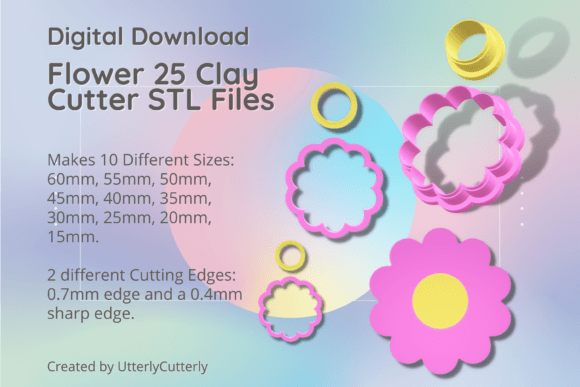
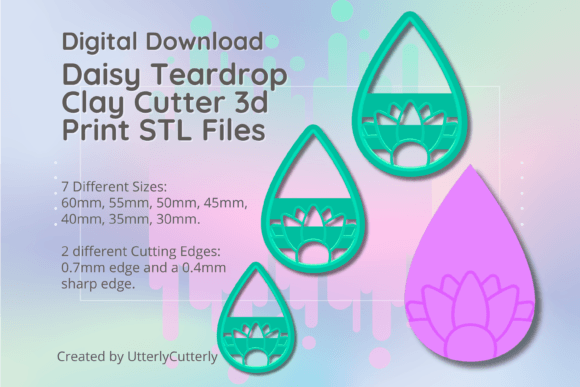
When assessing the utility of this STL bundle, the primary consideration is the inclusion of two distinct cutting edge geometries. This dual-option approach addresses the common limitation of generic cutter files that fail to account for different material viscosities. The pack includes seven graduated sizes ranging from 30mm to 60mm, measured from the longest ends of the daisy silhouette.
- Standard Edge (0.7mm Wall): This variant features a 0.7mm wall thickness with a 3mm thick base and a total height of 12mm. It is engineered for durability and ease of printing, making it suitable for softer clays, fondant, or cookie dough where extreme sharpness is less critical than structural integrity.
- Sharp Edge (SE): Abbreviated as SE in the file naming convention, this version utilizes a 1mm support wall transitioning to a 0.4mm cutting edge. While maintaining the same 3mm base and 12mm height as the standard version, the refined edge geometry allows for cleaner cuts in polymer clay and detailed impression work.
Additionally, the embossing lines are set at 10.5mm tall. Users must note that this depth requires a substrate thicker than 1.5mm to function correctly without bottoming out or distorting the clay. This specification is critical for planners determining compatibility with their standard slab thicknesses.
Evaluating Printability and Manufacturing Feasibility
A significant factor in selecting digital cutter files is the ease of fabrication. These STL files are explicitly designed for printability, reducing the trial-and-error phase often associated with complex organic shapes. The 3mm base provides adequate adhesion surface area for printer beds, minimizing warping risks common with thin-walled objects. However, users should evaluate their printer’s capabilities before purchase.
The Sharp Edge (SE) variant presents specific manufacturing tradeoffs. While the 0.4mm cutting edge offers superior performance, it approaches the minimum resolution limits of many standard 0.4mm nozzle FDM printers. Successful printing of the SE files typically requires fine-tuning flow rates, utilizing smaller nozzles (0.2mm or 0.25mm), or switching to resin printing technology. Users relying solely on entry-level FDM printers may find the Standard Edge variant more practical, as the 0.7mm wall is forgiving of minor calibration issues while still providing adequate definition for most crafting applications.
Material Compatibility and Application Scenarios
The versatility of the Daisy Clay Cutter STL Digital File extends across multiple mediums, though performance varies by application. For polymer clay artists, the SE variant is generally preferred due to its ability to slice through firm materials without dragging or deforming delicate petal tips. The 12mm height accommodates deep slabs and allows for easy extraction of the cut piece. Conversely, the Standard Edge is often sufficient for ceramic clay, where the material's plasticity allows for clean release even with slightly thicker walls.
In culinary applications, such as cookie or fondant decoration, the choice between edge types depends on the desired finish. The Standard Edge produces a slightly rounded perimeter that can be desirable for baked goods, whereas the SE variant creates crisp edges better suited for intricate royal icing work or gum paste flowers. Bakers must also consider food safety; while PLA is generally considered non-toxic, 3D printed layer lines can harbor bacteria. Proper post-processing, including sealing with food-safe epoxy or using dedicated food-only printers, is a mandatory consideration for any culinary use case.
Strategic Benefits of Digital Bundles
Opting for a digital bundle over individual physical cutters offers distinct logistical and economic advantages. The inclusion of seven sizes (30mm, 35mm, 40mm, 45mm, 50mm, 55mm, and 60mm) enables immediate scaling for nested designs or graduated jewelry sets without waiting for additional shipments. This is particularly valuable for production artists who need to prototype size variations rapidly.
Furthermore, the digital format supports iterative customization. Because new STL files are added to the store weekly, this daisy pack can serve as a foundational element in a growing library of compatible tools. Users can mix and match these daisy cutters with other floral or geometric files from the same ecosystem, ensuring consistent wall thicknesses and base dimensions across different toolsets. This interoperability reduces the cognitive load when planning complex projects, as the user does not need to adjust techniques for mismatched cutter geometries.
Considerations and Limitations
Despite the advantages, potential users must weigh specific limitations inherent to digital fabrication. The most immediate constraint is the requirement for hardware ownership and technical proficiency. This product is not a physical tool; access is granted only after payment via digital download. Individuals without access to a reliable 3D printer or the willingness to learn slicing software parameters will not derive value from this purchase.
Quality assurance also shifts from the manufacturer to the end-user. While all cutters are tested as part of a standard quality checking system before being listed as STL files, the final output quality depends entirely on local printer calibration, filament quality, and environmental conditions. A perfectly designed file can fail if printed with wet filament or on an unlevel bed. Buyers should view this product as a blueprint rather than a guaranteed finished good.
Finally, intellectual property and usage rights should be reviewed. Digital files typically come with licensing restrictions regarding commercial reproduction of the STL itself versus the sale of physical items made using the cutter. Artisans intending to sell products created with these daisy cutters must verify that the license permits commercial derivative works, distinguishing this from prohibited file sharing or resale of the digital asset.
Making the Final Decision
The Daisy Clay Cutter STL Digital File represents a strong fit for makers who prioritize customization, possess 3D printing infrastructure, and require specific dimensional tolerances for professional-grade results. It is ideal for those who understand the relationship between nozzle size and wall thickness and are comfortable managing print settings to achieve either durable standard edges or precise sharp edges.
Conversely, alternatives may be worth considering for hobbyists who lack printing equipment, require immediate tool availability without setup time, or prefer the tactile consistency of injection-molded steel or plastic cutters. If the primary goal is casual crafting without technical overhead, physical cutters eliminate the variable of print quality. However, for users seeking to curate custom cutter combos and maintain a scalable, on-demand tool inventory, this digital bundle offers a practical and versatile solution that balances detailed design with manufacturing feasibility.