Clay Cutter STL File Heart Sun- Vale: Digital Design Evaluation
The Clay Cutter STL File Heart Sun- Vale represents a specific category of digital fabrication assets designed for polymer clay artists, bakers, and crafters who own 3D printers. Unlike pre-manufactured metal or plastic cutters, this product is a downloadable bundle containing stereolithography files that allow users to produce their own tools on demand. The "Vale" design combines heart and sun motifs, offering a versatile aesthetic suitable for Valentine’s Day projects, summer-themed jewelry, or general decorative work. Evaluating this digital asset requires understanding not just the visual design, but the technical specifications, printing requirements, and practical applications inherent in the STL format.
Understanding the Digital Asset and Technical Specifications
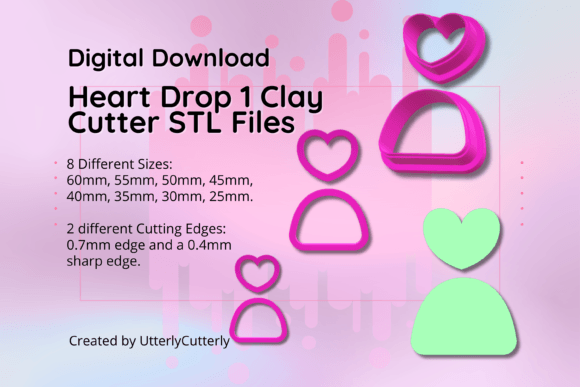
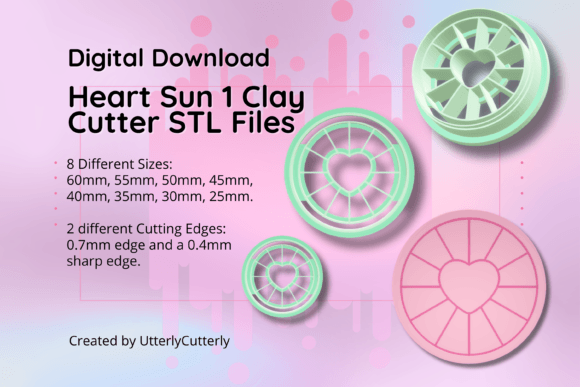
When assessing the Clay Cutter STL File Heart Sun- Vale, it is essential to recognize that this is strictly a digital download. No physical item will be shipped. The value proposition lies entirely in the utility of the files and the user's ability to print them successfully. This specific bundle is engineered with versatility in mind, providing eight distinct sizes ranging from 25mm to 60mm. This graduated sizing allows creators to produce matching sets, such as earring and pendant combinations, without needing to source multiple disparate products.
A critical differentiator in this STL pack is the inclusion of two distinct cutting edge profiles. Understanding the tradeoffs between these profiles is necessary for selecting the right tool for a specific medium:
- Standard Edge (0.7mm Wall): This version features a 0.7mm wall thickness with a 3mm thick base and a 12mm height. It offers greater structural rigidity and durability, making it suitable for stiffer clays or repeated use. However, the thicker wall may leave a slightly wider impression that requires more cleanup.
- Sharp Edge (SE): Abbreviated as SE in the file names, this variant utilizes a 1mm support wall tapering to a 0.4mm cutting edge. Like the standard version, it has a 3mm base and 12mm height. The sharper edge provides cleaner cuts with less deformation to the clay, which is ideal for detailed jewelry work or soft fondant. The tradeoff is reduced durability; thin edges are more susceptible to damage if excessive force is applied or if printed with insufficient layer adhesion.
Additionally, users must note that any embossing lines within the design are 1.5mm tall relative to the cutter depth. For these details to transfer effectively, the clay or dough must be rolled to a thickness exceeding 1.5mm. Attempting to use these cutters on thinner materials will result in incomplete impressions or structural failure of the finished piece.
Practical Applications and Material Compatibility
The primary appeal of the Clay Cutter STL File Heart Sun- Vale is its cross-medium compatibility. While marketed heavily toward polymer clay jewelers for creating earrings, pendants, and barrettes, the geometry is equally applicable to culinary uses. The 3D printed nature of these tools makes them appropriate for cookies and fondant, provided food-safe printing practices are observed. For jewelry makers, the availability of sizes from 25mm to 60mm facilitates the creation of cohesive collections. A maker can utilize the 30mm cutter for stud earrings and the 50mm or 60mm versions for statement pendants, ensuring design consistency across a product line.
For those focused on seasonal crafts, the heart-sun hybrid motif bridges the gap between specific holidays like Valentine’s Day and broader spring or summer themes. This extends the useful life of the cutter beyond a single event, improving the return on investment for the digital file. Furthermore, because the files are digital, they can be combined with other STL assets from the same ecosystem to curate custom cutter combos, allowing for unique design variations that off-the-shelf tools cannot provide.
Evaluating Benefits Against Tradeoffs
Choosing a digital STL file over a physical cutter involves distinct advantages and limitations that should be weighed carefully.
Benefits of the Digital Format
The most significant advantage is immediate access and reproducibility. If a physical cutter breaks or wears out, a replacement can be printed in hours rather than waiting for shipping. The cost-per-unit decreases significantly after the initial purchase, especially when utilizing the full range of eight sizes. Additionally, digital files allow for customization; advanced users can modify the STL in CAD software to adjust dimensions or add personalization before printing, a flexibility impossible with manufactured tools.
Considerations and Limitations
Conversely, the Clay Cutter STL File Heart Sun- Vale requires an upfront investment in hardware and time. Users must own a functioning 3D printer and possess basic slicing knowledge. Print failures, layer separation, or incorrect orientation can render a cutter unusable. There is also the consideration of post-processing; 3D printed cutters often require sanding to smooth layer lines, particularly on the cutting edge, to prevent tearing clay or leaving ridges in fondant. Physical metal cutters typically arrive ready to use with superior edge sharpness and longevity compared to PLA or resin prints.
Decision-Making Insights for Makers
Determining whether this digital bundle aligns with your workflow depends on several factors. The Clay Cutter STL File Heart Sun- Vale is likely a strong fit if you already own a 3D printer and regularly create jewelry or baked goods requiring specific, coordinated shapes. It is particularly valuable for small business owners who need to scale production without increasing per-unit tool costs, or for hobbyists who enjoy the process of tool-making as part of their craft. The dual-edge options also cater to makers who work with varying material densities, allowing one purchase to cover multiple needs.
However, alternatives may be worth considering in specific scenarios. If you do not own a 3D printer and have no intention of acquiring one, purchasing physical brass or stainless steel cutters is the only viable option. Even for printer owners, if you require industrial-grade durability for high-volume commercial production, metal cutters may offer better long-term performance. Additionally, if you only need a single size or plan to make fewer than five items, the time and material cost of printing may exceed the price of a single physical cutter.
Ultimately, the decision rests on balancing convenience against customization. This STL bundle offers extensive flexibility through its size range and edge variations, empowering users to tailor their tools to precise project requirements. By understanding the technical parameters—specifically the difference between the 0.7mm and Sharp Edge profiles and the minimum clay thickness for embossing—makers can effectively integrate the Clay Cutter STL File Heart Sun- Vale into their creative arsenal, maximizing both efficiency and artistic potential.