Split Daisy Teardrop Clay Cutter - STL: Evaluating Digital Designs for Polymer Clay and Baking
The transition from purchasing physical tools to acquiring digital assets represents a significant shift in how makers approach jewelry design and cookie decoration. The Split Daisy Teardrop Clay Cutter - STL offers a specific solution for artisans who own 3D printers and require precise, repeatable shapes that are difficult to achieve with freehand cutting or generic metal cutters. Unlike standard round daisy cutters, the split teardrop silhouette introduces an asymmetrical element that adds visual movement to finished pieces. When evaluating this digital download bundle, it is necessary to understand not just the aesthetic appeal, but the technical specifications, printing requirements, and practical limitations compared to traditional manufacturing methods.
Technical Specifications and Printability Assessment
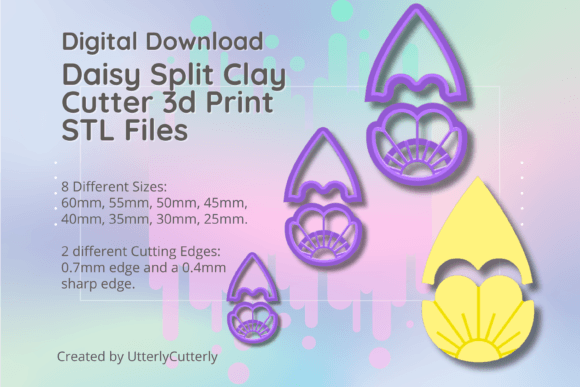
For users comparing various STL files, dimensional accuracy and print success rates are often more critical than the design itself. A poorly optimized file can lead to failed prints or fragile tools. This specific Split Daisy Teardrop Clay Cutter - STL bundle addresses these concerns through standardized sizing and dual-edge options. The pack includes eight distinct sizes measured from the longest ends: 60mm, 55mm, 50mm, 45mm, 40mm, 35mm, 30mm, and 25mm. This graduated sizing allows for nesting designs or creating cohesive collections across different scales, which is essential for earring sets or tiered cookie displays.
The bundle distinguishes itself by offering two distinct cutter profiles within the same download, catering to different material behaviors and user preferences:
- Standard Wall (0.7mm): Features a 0.7mm wall thickness with a 3mm thick base and a total height of 12mm. This option provides increased rigidity during the printing process and offers a sturdier grip when pressing into denser clays.
- Sharp Edge (SE): Abbreviated as SE in the file names, this variant utilizes a 1mm support wall tapering to a 0.4mm cutting edge. It shares the same 3mm base and 12mm height but is engineered specifically for cleaner cuts in soft polymer clay, reducing drag and deformation.
A critical specification for potential buyers is the embossing line height, set at 10.5mm. This indicates that the internal detailing requires a clay slab thicker than 1.5mm to function correctly. Users working with very thin veneers or delicate sheets may find the embossing feature ineffective, making this tool better suited for structural components rather than surface-only texturing.
Digital STL Bundles Versus Physical Metal Cutters
When deciding between downloading the Split Daisy Teardrop Clay Cutter - STL and purchasing a pre-made metal alternative, several tradeoffs must be weighed. Metal cutters generally offer superior longevity and heat resistance, making them the default choice for high-volume commercial baking or extremely stiff doughs. However, digital files offer advantages in customization and cost-efficiency for hobbyists and small-batch creators.
The primary advantage of the STL format is the ability to iterate. If a maker determines that the 45mm size is slightly too large for their specific earring hooks, they can scale the file in their slicer software before printing—a flexibility impossible with fixed-size metal tools. Furthermore, the sharp edge (SE) variant included in this digital pack mimics the cutting performance of high-end metal cutters while maintaining the ergonomic benefits of a 3D-printed handle base. Conversely, those without access to a reliable FDM printer or those unwilling to manage layer adhesion settings will likely find physical tools more practical despite the higher upfront cost per unit.
Evaluating Fit: Jewelry Making vs. Culinary Applications
While marketed as a versatile tool, the Split Daisy Teardrop Clay Cutter - STL performs differently depending on the medium. Understanding these nuances helps prevent frustration and material waste.
Polymer Clay and Jewelry Fabrication
This is the optimal use case for both cutter variants. The 12mm height provides ample clearance for most jewelry-grade clay slabs, and the 0.4mm Sharp Edge produces clean lines that minimize post-processing sanding. The split daisy shape is particularly effective for modern botanical jewelry, where the teardrop elongation complements ear anatomy better than circular florals. For resin work or UV curing, the PLA material typically used for these prints is compatible, provided the cutter is cleaned properly between uses to prevent residue buildup in the embossing lines.
Cookies and Edible Doughs
Users intending to use these cutters for food must exercise caution regarding material safety. Standard PLA filament is not inherently food-safe due to potential additives and layer lines that harbor bacteria. While the cutter geometry is suitable for fondant, gum paste, or cookie dough, the tool should only be used if printed with certified food-safe materials and sealed appropriately. Additionally, the 0.7mm standard wall is recommended over the SE variant for baking applications; the sharper 0.4mm edge can be too aggressive for firm doughs and may deform under the pressure required to cut through chilled pastry. The embossing feature works best with softer mediums like marzipan or rolled fondant rather than hard gingerbread.
Decision Factors: When to Choose This Digital Asset
Selecting the right digital cutter involves assessing your current workflow and equipment capabilities. The Split Daisy Teardrop Clay Cutter - STL is likely the correct choice if you meet the following criteria:
- You possess a dialed-in 3D printer: Successful printing of the SE variant requires precise nozzle calibration. If your printer struggles with thin walls or bridging, the 0.4mm cutting edge may fail or print inconsistently.
- You require size versatility: The inclusion of eight sizes eliminates the need to purchase multiple individual packs, making it cost-effective for creators experimenting with scale.
- You value testing and quality assurance: Unlike many open-source repositories, these files undergo standard quality checking before sale. This reduces the trial-and-error phase common with unverified free downloads.
- Your projects exceed 1.5mm thickness: As noted in the specifications, the embossing functionality is depth-dependent. Thin-sheet artisans should verify this constraint aligns with their techniques.
Conversely, readers should consider alternative resources if they lack 3D printing infrastructure, require immediate usage without print time, or need tools rated for industrial dishwasher sanitation. In such cases, sourcing physical stainless steel cutters or seeking out local makers who sell finished prints may be more efficient.
Practical Considerations for Digital Downloads
It is important to reiterate that this product is strictly a digital download. No physical item will be shipped. Access to the files is granted immediately after payment, allowing for instant integration into your design library. For those new to purchasing STL files for functional tools, ensure your slicer profile is updated to handle the specific wall thicknesses described. Printing the 0.7mm wall version with a 0.4mm nozzle, for example, may require adjusting extrusion width settings to ensure proper layer bonding.
Ultimately, the Split Daisy Teardrop Clay Cutter - STL serves as a specialized resource for makers seeking to bridge the gap between digital design and tactile creation. By offering dual edge profiles and a comprehensive size range, it accommodates varying skill levels and material types. However, its utility is entirely dependent on the user's ability to manufacture the tool effectively. Evaluating your printing capabilities against the technical requirements outlined above will determine whether this digital bundle enhances your creative toolkit or presents unnecessary technical hurdles.