Retro Ghost Clay Cutter - Retro Game STL: Evaluating Digital Fabrication for Polymer Clay and Baking
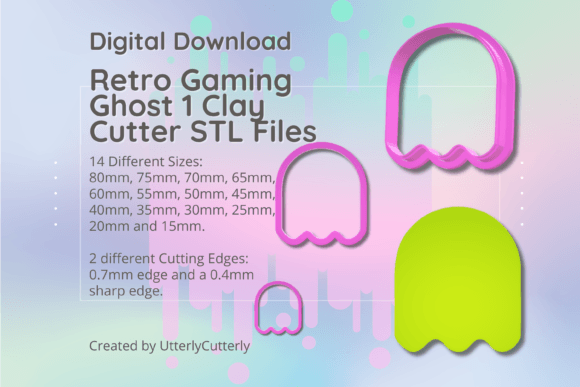
The intersection of nostalgic aesthetics and modern fabrication has created a niche market for specialized crafting tools. The Retro Ghost Clay Cutter - Retro Game STL represents a specific category of digital assets designed for makers who require precision, versatility, and thematic consistency in their work. Unlike mass-produced metal cutters or generic plastic shapes, this digital bundle offers a parametric approach to design, allowing users to print fourteen distinct sizes ranging from 15mm to 80mm. For adults evaluating whether to integrate 3D-printed tools into their polymer clay or baking workflows, understanding the technical specifications and practical tradeoffs of this STL file is essential for making an informed purchasing decision.
Digital Versatility Versus Traditional Manufacturing
When comparing the Retro Ghost Clay Cutter - Retro Game STL to traditional manufacturing options, the primary distinction lies in customization and inventory management. Standard retail cutters are typically sold in fixed sets with limited size variations. If a project requires a ghost silhouette at exactly 45mm for earring posts and another at 75mm for keychains, a maker might need to purchase two separate product lines. This digital download eliminates that friction by providing a comprehensive size gradient (15mm, 20mm, 25mm, 30mm, 35mm, 40mm, 45mm, 50mm, 55mm, 60mm, 65mm, 70mm, 75mm, and 80mm) in a single package.
This level of granularity is particularly relevant for jewelry designers working with polymer clay. The ability to scale a design without losing the specific "retro game" pixel-art aesthetic ensures visual cohesion across a collection. However, this flexibility comes with a prerequisite: access to a fused filament fabrication (FFF) 3D printer. Makers without printing capabilities must weigh the cost of acquiring hardware against the long-term savings of producing their own tools. While physical cutters offer immediate utility, the STL format serves those who view tool-making as part of their creative process rather than just a procurement step.
Analyzing Blade Geometry and Material Application
A critical factor in selecting any clay cutter is the blade profile, as this dictates both the finish of the piece and the durability of the tool. The Retro Ghost Clay Cutter - Retro Game STL addresses different use cases through two distinct cutting edge configurations included in the bundle. Understanding when to deploy each type is necessary for optimal results.
- Standard Edge (0.7mm Wall): This version features a 0.7mm wall thickness with a 3mm base and 12mm height. It is engineered for general-purpose polymer clay work where structural integrity of the cutter is paramount. The thicker wall reduces the risk of deformation during the pressing motion, making it suitable for firmer clay bodies or repetitive production runs. The tradeoff is a slightly less defined edge compared to thinner alternatives, which may require minor post-processing smoothing.
- Sharp Edge (SE - 0.4mm Cutting Edge): Abbreviated as SE in the file set, this variant utilizes a 1mm support wall tapering to a 0.4mm cutting edge. With the same 3mm base and 12mm height dimensions, this geometry prioritizes clean slicing over cutter longevity. It is ideal for softer clays, detailed impression work, or applications where minimizing drag marks is critical. Users should note that 0.4mm walls are more susceptible to layer separation if printed with insufficient perimeters or low-quality filament.
For bakers considering this STL for cookie dough, the Sharp Edge variant generally provides cleaner release and definition, provided the dough is chilled. The Standard Edge may be preferable for denser mediums like fondant or gum paste where resistance is higher. This dual-option approach distinguishes the file from many free or basic paid STLs that offer only a single, often unoptimized, blade thickness.
Technical Considerations for Printing and Embossing
Evaluating the quality of a digital cutter file requires looking beyond the shape itself to the functional tolerances built into the model. The Retro Ghost Clay Cutter - Retro Game STL includes specific parameters for embossing lines, which are set at 10.5mm tall. This dimension is not arbitrary; it is calculated to interact correctly with clay slabs thicker than 1.5mm.
Makers accustomed to shallow embossers may find this depth significant. The advantage is a pronounced texture that remains visible even after sanding and finishing. The limitation is that it cannot be used effectively on very thin veneers or sheets under 1.5mm without risking puncture or distortion. When comparing this to alternative retro-themed cutters, verify whether competitors specify embossing depths relative to material thickness. Many generic files lack this documentation, leading to trial-and-error waste. Having explicit dimensional data allows for better workflow planning, ensuring you condition your clay to the appropriate gauge before cutting.
Sizing Methodology and Project Planning
It is important to clarify how sizing is measured to avoid mismatches in project planning. The sizes listed for this bundle (from 15mm to 80mm) are measured from the longest ends of the ghost silhouette. Because the retro game ghost shape is often wider than it is tall, or possesses irregular pixelated protrusions, the bounding box dimensions may differ from the perceived visual size.
When curating custom combos with other STL files from the same ecosystem, maintain consistent measurement standards. Mixing cutters measured by width with those measured by height can result in disproportionate jewelry sets. The inclusion of fourteen incremental sizes facilitates precise nesting and layout optimization on clay sheets, reducing scrap material. For example, a maker can nest a 30mm cutter inside the negative space of a 60mm cutter layout, a strategy difficult to execute with non-scaled physical tools.
Decision Factors: When This STL Is the Right Fit
The Retro Ghost Clay Cutter - Retro Game STL occupies a specific position in the maker resource landscape. Determining whether it aligns with your needs involves assessing your production volume, aesthetic requirements, and technical comfort level.
Ideal Use Cases:
- Thematic Collections: Creators focusing on gaming nostalgia, Halloween markets, or synthwave aesthetics will benefit from the specific pixel-art styling that generic ghost cutters cannot replicate.
- Scale-Dependent Design: Jewelry artists requiring matched sets (e.g., stud earrings at 20mm and pendants at 50mm) gain efficiency from the unified design language across all fourteen sizes.
- Iterative Prototyping: Makers who frequently adjust designs based on customer feedback can reprint modified versions instantly without waiting for shipping or minimum order quantities.
- Dual-Medium Artists: Those working in both polymer clay and baking can utilize a single asset library for multiple revenue streams, maximizing the ROI of the digital purchase.
Situations Requiring Alternatives:
- Immediate Need Without Hardware: If you lack a 3D printer and do not wish to outsource printing services, physical brass or stainless steel cutters remain the superior choice for instant gratification.
- High-Temperature Industrial Baking: While PLA and PETG are food-safe for brief contact with cool dough, they are not suitable for high-heat environments. Commercial bakeries requiring oven-safe tools should stick to metal.
- Ultra-Fine Detail Requirements: While the SE variant is sharp, resin-printed or laser-cut steel tools may still offer superior edge definition for micro-jewelry below 15mm.
Evaluating Long-Term Value and Ecosystem Integration
Purchasing a digital file is fundamentally different from buying a physical tool. The value proposition of the Retro Ghost Clay Cutter - Retro Game STL extends beyond the initial transaction. As part of a store that releases new STL files weekly, this asset functions as a modular component in a growing system. Buyers should evaluate whether the existing catalog aligns with their long-term brand direction. Investing in a cohesive digital library prevents the stylistic dissonance that occurs when mixing assets from disparate designers.
Furthermore, consider the maintenance aspect. Physical cutters can bend, rust, or dull over time. A digital file does not degrade. If a printed cutter breaks during use, the replacement cost is merely the price of filament and electricity. This resilience makes digital assets particularly attractive for high-volume production environments where tool wear is a recurring expense. However, this assumes the user maintains printer calibration. Poorly tuned machines will produce inaccurate cutters regardless of file quality. Therefore, the suitability of this product is intrinsically linked to the user's proficiency with additive manufacturing.
Ultimately, the decision to acquire this bundle should be based on a realistic assessment of your current workflow. For makers seeking to bridge the gap between retro digital culture and tangible craft, and who possess the technical means to realize these files, this collection offers a balanced combination of aesthetic specificity and functional adaptability. By weighing the blade options, respecting the embossing tolerances, and leveraging the extensive size range, users can create professional-grade outputs that stand apart from standard market offerings.