Evaluating the 10mm Wide Circle Bezel Clay Cutter for Polymer Clay and Baking
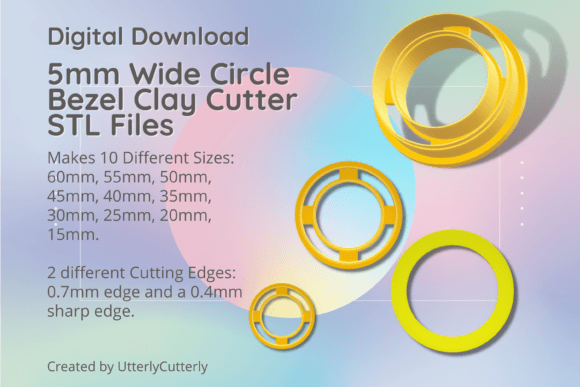
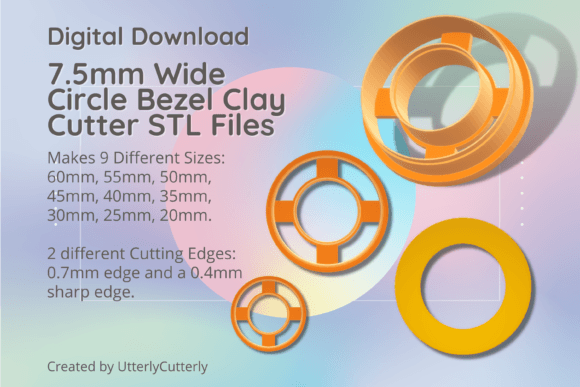
When selecting tools for polymer clay jewelry or edible decorations, the specific geometry of a cutter dictates not only the shape but also the structural integrity of the final piece. The 10mm Wide Circle Bezel Clay Cutter represents a specialized category of shaping tools designed to create broad, uniform frames rather than solid shapes or thin outlines. Unlike standard round cutters that produce discs, or delicate outline cutters that create wire-like borders, this tool generates a substantial 10mm band. This width is significant because it provides ample surface area for sanding, texturing, and finishing without compromising the durability of the clay during handling.
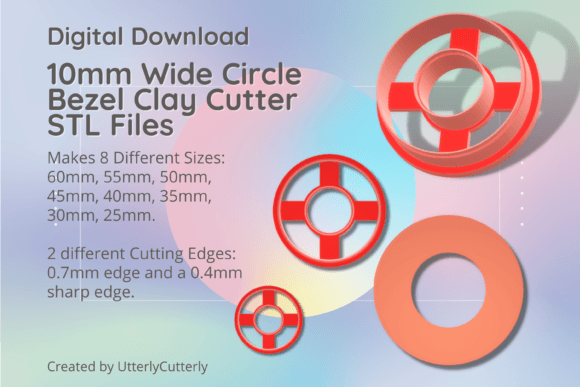
For makers utilizing digital fabrication, accessing these specific geometries often comes through STL files rather than physical inventory. A digital download bundle containing eight distinct sizes—ranging from 25mm to 60mm in diameter—allows for precise scaling and customization that pre-manufactured plastic cutters cannot offer. Understanding the technical specifications and practical applications of this bezel style is essential for determining whether it fits your current production workflow or if an alternative cutting method would yield better results for your specific project.
Distinguishing Bezel Geometry from Standard Round Cutters
The primary distinction between a 10mm Wide Circle Bezel Clay Cutter and a standard round cutter lies in the intended negative space. Standard cutters are typically single-walled blades meant to define an outer perimeter. In contrast, a bezel cutter functions as a frame generator. It removes the center material while leaving a wide, consistent border. This difference impacts how the clay behaves during the cutting process and subsequent finishing stages.
A 10mm width offers specific mechanical advantages over thinner alternatives. When working with polymer clay, borders narrower than 3mm can easily warp during baking or snap during sanding. The 10mm dimension creates a robust canvas suitable for embedding mica powders, applying alcohol inks, or setting small cabochons. Conversely, if your goal is to create lightweight, lace-like filigree or minimal stacking rings, this cutter may be too bulky. Makers focused on fine detail work might find that a dedicated outline cutter or a needle tool provides greater precision, whereas the bezel cutter excels at creating bold, architectural statements in earrings, pendants, and barrettes.
Comparing Digital STL Files to Physical Manufacturing
Choosing between downloading an STL file and purchasing a physical cutter involves evaluating tradeoffs between immediate availability and long-term versatility. Physical cutters arrive ready to use but are limited to fixed sizes and shipping logistics. If a maker requires a 48mm cutter for a specific earring design but only owns 45mm and 50mm options, they must compromise or wait for new stock. The digital format eliminates this gap by providing exact intermediate sizes within the same bundle.
However, the digital route shifts the manufacturing burden to the user. Success depends entirely on printer calibration and material choice. While the files are designed for ease of printing, achieving a functional cutting edge requires understanding layer adhesion and nozzle sizing. For hobbyists without access to a reliable FDM or resin printer, physical tools remain the more practical entry point. For those with established printing workflows, the STL bundle offers superior cost-efficiency and the ability to replace worn tools instantly without recurring shipping costs.
Analyzing Cutting Edge Variations: Sharp vs. Standard
This specific digital bundle includes two distinct cutter profiles, each serving different material requirements and finish preferences. Selecting the correct edge type is critical for minimizing post-processing labor and preventing material drag.
- Standard Wall (0.7mm): This version features a 0.7mm wall thickness with a 3mm base and 12mm height. It prioritizes durability and rigidity. The thicker wall is less likely to flex when pressing into firm clay or stiff fondant, making it ideal for beginners or for materials that offer significant resistance. However, the wider contact area can sometimes compress the clay edges slightly, requiring light cleanup after cutting.
- Sharp Edge (SE): Abbreviated as SE in the file set, this variant utilizes a 1mm support wall tapering to a 0.4mm cutting edge. Despite having a supportive structure, the actual contact point is significantly finer. This reduces friction and produces a cleaner slice through soft polymer clay and cookie dough. The tradeoff is fragility; the SE version requires careful handling and may wear faster if used with abrasive clay bodies containing heavy glitter or sand.
Makers should evaluate their primary medium when choosing between these types. For soft, sticky clays like Sculpey Soufflé or fresh fondant, the Sharp Edge minimizes sticking and deformation. For firmer clays like Cernit or Kato Polyclay, or for repetitive production runs where tool longevity matters, the 0.7mm standard wall often provides a better balance of performance and lifespan.
Sizing Strategy and Proportional Harmony
The inclusion of eight sizes (25mm, 30mm, 35mm, 40mm, 45mm, 50mm, 55mm, and 60mm) addresses a common challenge in jewelry design: proportional scaling. Measurements for these cutters are taken from the longest outer ends, meaning the internal open space will be exactly 20mm smaller than the stated size due to the 10mm width on both sides. This mathematical consistency allows for predictable nesting and pairing.
For example, a 40mm cutter yields a 20mm inner diameter, which pairs perfectly with a 20mm solid circle cutter or a 20mm cabochon. This interoperability is difficult to achieve with random assortment packs. When curating custom combos, having 5mm increments enables subtle gradation in earring sets or pendant collections. Larger sizes like 55mm and 60mm are particularly valuable for statement pieces or hair accessories like barrettes, where structural mass prevents breakage during wear. Smaller sizes such as 25mm and 30mm serve as accent components or studs. Evaluating your existing inventory against these specific dimensions helps determine if this bundle fills gaps or duplicates capabilities you already possess.
Technical Considerations for Embossing and Material Thickness
A crucial specification for users intending to combine cutting with texture is the embossing line height. In this file set, any integrated embossing elements stand 10.5mm tall. Given that the total cutter height is 12mm, this leaves only 1.5mm of clearance above the texture. This specification acts as a hard limit for material application.
If your clay slab is thinner than 1.5mm, the cutter bottom will hit the work surface before the embossing feature fully engages, resulting in shallow or incomplete impressions. Conversely, using clay significantly thicker than 1.5mm ensures full impression depth but may require additional pressure to cut through completely. This makes the tool best suited for standard jewelry-making thicknesses (typically 2mm to 3mm). For bakers using this for cookies or fondant, rolling guides set to at least 2mm are recommended to ensure both the cut and the decoration transfer effectively. Users working exclusively with paper-thin veneers or translucent sheets should recognize this limitation and consider shallower texture plates or separate stamping tools instead.
Printability and Design Optimization
The value of an STL bundle is contingent on successful fabrication. These files are explicitly designed for printability, featuring 3mm thick bases that promote bed adhesion and reduce warping during the print cycle. The 12mm overall height provides sufficient grip for hand use while remaining within reasonable print times for batch production.
When comparing this digital option to generic free files found on open repositories, the distinction often lies in these usability-focused design choices. Generic circle cutters frequently lack reinforced bases, leading to failed prints or uncomfortable tools that dig into the user's hand. The dual-edge inclusion further suggests a design intent focused on functional versatility rather than mere geometric novelty. For makers evaluating resources, verifying that STL files include these ergonomic and structural considerations is as important as checking the dimensional accuracy. A file that prints easily and functions comfortably saves hours of troubleshooting and post-processing, justifying the investment in curated digital assets over unverified alternatives.
Determining Fit: When to Choose This Bundle
The 10mm Wide Circle Bezel Clay Cutter bundle is a strong fit for intermediate to advanced makers who require dimensional consistency and have access to 3D printing. It is particularly relevant for those producing bezel-set jewelry, framed pendants, or uniform cookie decorations where the 10mm band width is a deliberate design element. The range of sizes supports collection-based design work, allowing for cohesive product lines rather than isolated pieces.
Conversely, this resource may not be optimal for makers seeking organic, irregular shapes or those working primarily with extremely soft, high-moisture media that requires non-stick coated metal tools. Additionally, absolute beginners who have not yet calibrated their printers may face a steep learning curve; starting with inexpensive physical cutters to understand clay behavior before investing time in digital fabrication is often a more efficient path. Ultimately, the decision rests on balancing the need for precise, customizable framing tools against the effort required to manufacture them. For those who value specificity and self-sufficiency in their toolkit, this digital bundle offers a practical solution that bridges the gap between industrial uniformity and handmade customization.