Cow Clay Cutter - Bull STL Digital File: Versatile Designs for Polymer Clay and Baking
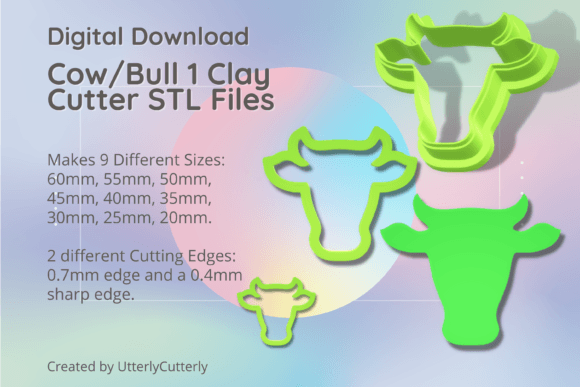
Creating custom jewelry or themed baked goods often comes down to having the right silhouette, and the Cow Clay Cutter - Bull STL Digital File provides exactly that precision in a downloadable format. This digital asset is more than just a single shape; it is a comprehensive toolkit designed for makers who need flexibility in their production line. Whether you are crafting western-themed polymer clay earrings or baking farm-animal cookies for a children’s party, this bundle offers immediate access to professional-grade cutter geometry without waiting for shipping. The file includes two distinct cutting edge profiles and nine different sizes, allowing you to scale your projects from delicate stud earrings to substantial statement pieces or standard-sized treats.
Choosing the Right Edge Profile for Your Material
One of the most critical aspects of working with 3D printed cutters is understanding how blade geometry interacts with different mediums. This STL pack solves the common frustration of "one-size-fits-all" blades by including two specialized cutter types tailored for specific applications.
The Standard 0.7mm Wall
The first option features a 0.7mm wall thickness with a 3mm thick base and a 12mm height. This profile is the workhorse for general-purpose use. In real-world scenarios, this sturdier edge is ideal for:
- Polymer Clay Conditioning: When working with firmer clays like Sculpey III or Cernit, the slightly thicker wall provides enough rigidity to push through the material without flexing or snapping.
- Fondant and Gum Paste: For cake decorators, this edge offers a clean cut on rolled sugar pastes while being durable enough to withstand repeated washing and handling in a busy kitchen.
- Beginner Makers: If you are new to 3D printing cutters, this tolerance is generally more forgiving during the slicing and printing process, reducing the risk of failed prints due to walls being too thin for your nozzle size.
The Sharp Edge (SE) Variant
Abbreviated as SE in the file names, this variant features a 1mm support wall tapering to a precise 0.4mm cutting edge. It shares the same 3mm base and 12mm height but serves a completely different purpose. This knife-like edge is essential when detail matters more than durability. You will find this invaluable when cutting soft, sticky materials like porcelain clay or soft-conditioned polymer clay where drag can distort the shape. The sharper bevel slices rather than pushes, preserving intricate details of the bull silhouette. It is also preferred for creating crisp edges on leather clay or when making very thin jewelry components where minimizing post-print sanding is a priority.
Sizing Strategy for Jewelry and Earring Design
Jewelry makers know that visual weight changes dramatically with scale. A bull shape that looks bold at 60mm might appear chunky at 45mm, yet perfect for a necklace pendant. This digital download addresses that nuance by providing a graduated size range measured from the longest ends: 60mm, 55mm, 50mm, 45mm, 40mm, 35mm, 30mm, 25mm, and 20mm.
This granularity allows for curated collections rather than isolated pieces. For example, a maker could use the 60mm and 55mm sizes for large statement dangles, step down to 40mm and 35mm for standard everyday wear earrings, and utilize the 25mm and 20mm versions for matching studs or charm bracelets. Having all these sizes in one STL bundle eliminates the guesswork of scaling files in slicer software, which can sometimes distort aspect ratios or make walls unprintable. You maintain consistent wall thickness and structural integrity across every size variation.
Working with Embossing Lines
For those utilizing the embossing features included in the design, practical application requires specific attention to clay depth. The embossing lines stand 10.5mm tall, which means they are engineered to interact with clay sheets thicker than 1.5mm. Attempting to use these detailed cutters on paper-thin clay will result in the blade hitting your work surface before the embossing detail fully registers. Rolling your clay to a consistent 2mm or 2.5mm ensures the internal details of the bull design press cleanly into the material without cutting through unintentionally. This depth consideration is vital for achieving professional-looking texture on pendants and larger decorative elements.
Practical Considerations for 3D Printing Cutters
Since this is a digital file and not a physical product, your success depends heavily on printer calibration and material choice. While these files are designed to be easily printed, real-world results vary based on hardware.
- Nozzle Selection: For the Sharp Edge (SE) files, a 0.4mm nozzle is typically the minimum requirement, though a 0.2mm nozzle will yield superior edge definition. The standard 0.7mm wall files print reliably on both 0.4mm and 0.6mm nozzles.
- Material Safety: Always consider food safety if using these for baking. PLA is biodegradable but porous, harboring bacteria over time. PETG or food-safe ABS is recommended for cookie cutters, and these should always be hand-washed in cool water. Never put 3D printed cutters in a dishwasher, as the heat can warp the precise tolerances of the bull shape.
- Layer Height: Printing at 0.12mm or 0.16mm layer heights produces smoother cutting edges that require less post-processing. Higher layer heights create ridges that can drag through soft clay, marring the surface finish of your final piece.
- Brim vs. Raft: Given the 3mm thick base, a brim is usually sufficient for adhesion. Avoid rafts unless absolutely necessary, as removing raft material from a detailed cutting edge can be tedious and risks damaging the blade profile.
Expanding Your Creative Toolkit
The utility of the Cow Clay Cutter - Bull STL Digital File extends beyond its immediate shape. Because it is part of a growing ecosystem with new STL files added weekly, it encourages a modular approach to creation. Makers can mix this bovine silhouette with other western, floral, or geometric cutters from the same store to develop cohesive product lines. The consistent sizing conventions across bundles mean you can confidently plan a collection knowing that a 40mm bull cutter will have proportional visual weight to a 40mm cactus or star cutter from the same designer.
This interoperability is particularly valuable for small business owners managing inventory. Instead of buying random individual cutters that don't coordinate, you can curate custom and unique cutter combos that share design DNA. The digital nature of the product also means instant gratification; there is no lead time between inspiration and execution. After payment, you have immediate access to download the files, allowing you to prototype new designs the same evening you conceive them. This agility is crucial in trend-driven markets like handmade jewelry and seasonal baking, where timing can determine commercial success.
Ultimately, this digital file represents a shift toward customizable, on-demand manufacturing for individual creators. By understanding the distinctions between edge types, respecting material constraints regarding embossing depth, and leveraging the full spectrum of available sizes, users can transform a simple STL download into a versatile production asset that serves both artistic vision and practical necessity.