Fish 1 Clay Cutter STL Digital File: Precision Tools for Polymer Clay and Baking
Creating intricate details in polymer clay or achieving uniform shapes in cookie dough requires more than just steady hands; it demands precision tooling. The Fish 1 Clay Cutter - STL Digital File Download bridges the gap between digital design and tangible craftsmanship, offering makers a versatile solution for aquatic-themed projects. Whether you are sculpting delicate jewelry components or baking themed treats for an ocean party, having access to professionally designed 3D printable files ensures consistency and quality that free, generic models often lack.
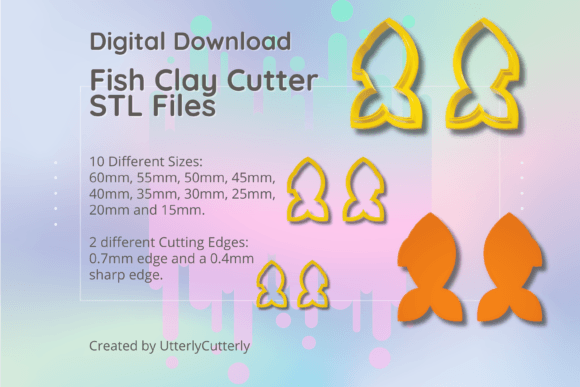
This specific digital bundle is engineered for immediate utility. Rather than offering a single static shape, this pack provides a comprehensive system of ten distinct sizes and two specialized cutting edge profiles. This level of variation allows artisans to curate custom cutter combos easily, scaling their work from miniature charm-sized pieces to substantial statement items without losing the integrity of the original fish silhouette. Because these are STL files designed for easy printing, they integrate seamlessly into modern maker workflows where customization and on-demand production are paramount.
Understanding Cutting Edge Profiles for Different Materials
One of the most critical considerations when selecting a clay cutter STL is the blade geometry. Not all materials behave identically under pressure, and using the wrong edge type can result in tearing, dragging, or undefined edges. This Fish 1 bundle addresses this challenge by including two distinct cutter types within the same download, ensuring you have the right tool for your specific medium.
The Standard 0.7mm Wall Configuration
The first option features a robust 0.7mm wall thickness with a 3mm thick base and a total height of 12mm. This profile is the workhorse of polymer clay crafting. The slightly thicker wall provides structural rigidity during the cutting process, preventing the cutter from flexing when pressed into firmer clays like Sculpey III or Kato Polyclay. The 3mm base offers a comfortable surface area for your thumb or palm, distributing pressure evenly so you can achieve a clean cut without hand fatigue. This version is ideal for general shaping, slab building, and creating outlines that need to hold their form before baking.
The Sharp Edge (SE) Variant
For projects requiring extreme definition, the bundle includes the Sharp Edge variant, abbreviated as "SE" in the file names. This design utilizes a 1mm support wall that tapers down to a razor-thin 0.4mm cutting edge. Like the standard version, it maintains a 3mm thick base and 12mm height for ergonomic handling. The SE cutters are specifically optimized for softer materials or situations where minimal resistance is key. They excel at cutting soft porcelain clay, fondant, gum paste, or cookie dough where a thicker blade might drag or distort the material. In polymer clay, the SE variant is perfect for slicing through thin veneers or creating crisp edges on delicate jewelry pieces where every fraction of a millimeter counts.
Strategic Sizing for Scalable Design Workflows
Versatility in scale is what separates a novelty item from a professional toolset. When working with the Fish 1 Clay Cutter - STL Digital File Download, users gain access to a graduated sizing system measured from the longest ends of the design. This logical progression allows for nested designs, gradient arrangements, or size-specific adaptations for different end uses.
- Large Format (60mm, 55mm, 50mm): These sizes are optimal for cookie cutters, large pendants, or decorative tiles. The larger surface area makes them excellent for incorporating internal textures or embossing details.
- Medium Format (45mm, 40mm, 35mm): The sweet spot for standard earrings, brooches, and cake toppers. These sizes balance visibility with material economy.
- Small Format (30mm, 25mm, 20mm, 15mm): Essential for micro-jewelry, stud earrings, ring blanks, and detailed scene building. The 15mm cutter is particularly useful for creating accent pieces or charms that complement larger focal beads.
Having this range pre-calculated saves significant time in the design phase. Instead of attempting to resize a single STL file in slicer software—which can sometimes distort wall thicknesses or make blades too fragile to print—you receive files that have been mathematically adjusted to maintain structural integrity at every scale. This ensures that even the smallest 15mm cutter prints reliably and functions correctly.
Technical Considerations for Embossing and Print Success
Beyond simple outline cutting, many makers utilize these tools for texture and depth. It is important to note that if there are any embossing lines integrated into the Fish 1 design, they are set at a height of 10.5mm. This specification is deliberate. For an embossed impression to register clearly without bottoming out, your clay slab must be thicker than 1.5mm. Attempting to use these embossing features on paper-thin clay will result in the cutter hitting the work surface before the detail is fully transferred, potentially damaging both your mat and the printed tool.
When preparing to print these files, consider your printer’s capabilities. While the cutters are designed to be easily printed, the 0.4mm SE blades require a well-tuned machine. Ensure your flow rate is calibrated and your nozzle is clean to prevent clogging on the fine edges. Using a 0.4mm nozzle is generally recommended for both cutter types to balance print speed with detail resolution. PLA is the standard material choice due to its stiffness and biodegradability, but PETG can be used for the standard 0.7mm cutters if you require higher heat resistance for occasional warm-water cleaning. Always verify layer adhesion, as clay cutters undergo lateral stress during use; increasing wall loops or perimeter count in your slicer settings can significantly extend the lifespan of your printed tools.
Integrating Digital Files into Creative Business Models
For sellers on platforms like Etsy or makers attending craft fairs, the ability to rapidly prototype and produce custom tools is a competitive advantage. Purchasing the Fish 1 Clay Cutter - STL Digital File Download eliminates shipping wait times and allows for instant inventory expansion. New STL files are added to the store weekly, enabling creators to build a cohesive library of compatible shapes. This ecosystem approach means your fish cutters can eventually be paired with coral, shell, or wave designs from the same source, ensuring stylistic consistency across entire product collections.
Furthermore, owning the digital asset means you can replace worn tools instantly. Physical plastic cutters eventually degrade; edges dull, layers separate, or they snap under pressure. With the STL file secured in your digital library, replacement is merely a matter of hitting "print" again. This sustainability aspect reduces waste and long-term costs, aligning with the values of many eco-conscious crafters who prefer repairing or remaking over discarding.
Important Usage and Safety Guidelines
As this is a digital download and not a physical item, access to the files is granted immediately after payment confirmation. Users should understand that 3D printed tools have limitations compared to injection-molded steel. They are intended for hobbyist and small-business use with appropriate materials. Never use these PLA or PETG cutters with hot sugar work or materials exceeding the glass transition temperature of your filament, as the tool may deform. Additionally, while the SE blades are sharp enough to cut clay effectively, they are not knife-sharp and pose minimal safety risk during normal handling, but care should always be exercised when removing supports or cleaning fine details.
By leveraging the precision, variety, and accessibility of this STL bundle, makers can elevate their aquatic-themed creations with confidence. Whether producing a batch of uniform fish cookies or a graduated set of polymer clay earrings, the right digital tool transforms creative vision into consistent, professional reality.