Open Letter Envelope Clay Cutter - STL Digital Files: Integrating Precision Tools into Your Creative Workflow
In the landscape of polymer clay jewelry making and cookie decorating, consistency is often the dividing line between amateur experimentation and professional production. The Open Letter Envelope Clay Cutter - STL Digital Files serves as a critical asset in bridging this gap. Rather than relying on freehand cutting or generic shapes that lack specific detailing, this digital bundle provides a standardized foundation for creating open envelope designs. For creators, educators, and small business owners, integrating these STL files into your workflow is not merely about acquiring a shape; it is about establishing a repeatable process that ensures quality control, reduces material waste, and streamlines the transition from digital design to physical product.
Understanding the Asset in a Production Context
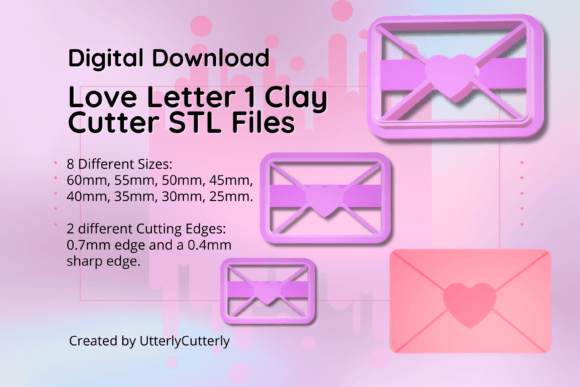
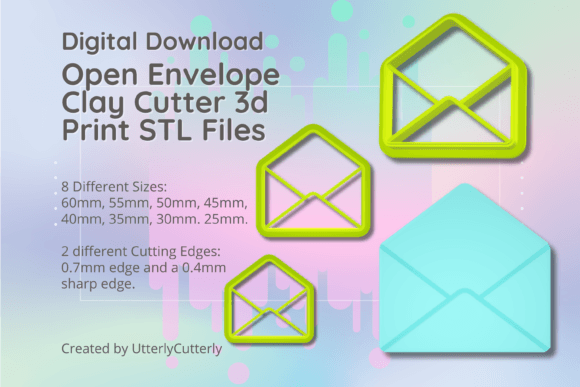
This product is strictly a digital download, meaning its value lies entirely in how effectively you integrate the files into your existing 3D printing and crafting ecosystem. The bundle includes eight distinct sizes ranging from 25mm to 60mm, measured from the longest ends. This graduated sizing system is intentional, allowing for modular design work. Whether you are prototyping a new earring collection or preparing bulk orders for wedding favors, having precise dimensional variations eliminates the guesswork associated with scaling physical cutters manually.
The inclusion of two distinct cutting edge profiles within the same file pack addresses different stages of the creative process. Understanding when to deploy the standard 0.7mm wall versus the Sharp Edge (SE) variant is essential for workflow efficiency. The standard cutter features a 0.7mm wall, a 3mm thick base, and a 12mm height, making it robust enough for repeated use in high-volume production environments. Conversely, the SE variant maintains the same base and height dimensions but utilizes a 1mm support wall with a 0.4mm cutting edge. This distinction allows makers to select the appropriate tool based on the material's viscosity and the desired finish, reducing post-processing time significantly.
Pre-Production Planning and File Management
Before initiating a print job, proper file organization is necessary to maximize the utility of this bundle. Because new STL files are added to the store weekly, maintaining a structured digital library prevents version conflicts and ensures you are always using the tested, quality-checked files. We recommend creating a dedicated directory structure categorized by size and edge type. Since the embossing lines are designed at 10.5mm tall, they interact specifically with clay thicker than 1.5mm. Documenting this specification in your project planning phase prevents material incompatibility issues later in the execution stage.
For those managing a business or teaching a class, this pre-production phase also involves verifying printer compatibility. While these cutters are designed to be easily printed, achieving the precise 0.4mm edge on the SE variant requires a well-calibrated machine. Incorporating a test print protocol into your setup routine ensures that the digital asset translates accurately to physical form. This step is vital for maintaining the integrity of the embossing details, which are central to the open letter envelope aesthetic.
Execution Strategies for Jewelry and Culinary Applications
The versatility of the Open Letter Envelope Clay Cutter - STL Digital Files becomes apparent during the active creation phase. In jewelry fabrication, the 25mm through 40mm sizes are typically utilized for pendants and charms, while the larger 45mm to 60mm variants serve as statement pieces or component bases for complex assemblies. The 12mm height of the cutter provides ample clearance for clay removal, a practical feature that maintains workflow momentum by preventing material from sticking inside the tool. When working with polymer clay, the sharp edge variant produces cleaner cuts that require less sanding, directly impacting labor hours per unit.
In culinary applications, such as cookie decorating, the standard 0.7mm wall offers durability against stiffer doughs. The embossing lines add texture without compromising the structural integrity of the baked good. Because the cutter sizes are standardized, bakers can plan packaging and display layouts with mathematical precision. This interoperability between the digital file specifications and physical output constraints is what transforms a simple cutter into a comprehensive production tool. Users can easily curate custom combos by pairing these envelope cutters with other STL files from the same ecosystem, ensuring visual and dimensional harmony across diverse product lines.
Quality Control and Long-Term Maintenance
All cutters in this bundle undergo testing as part of a standard quality checking system before being listed. However, long-term performance depends on user maintenance and proper implementation. For 3D printer owners, regular nozzle calibration is required to maintain the tolerance needed for the 0.4mm cutting edges. A worn nozzle will degrade the SE variant’s performance over time, turning a precision tool into a generic shaper. Establishing a maintenance schedule for your printing equipment ensures that the digital files continue to produce results that match the original tested specifications.
From a business perspective, tracking the lifespan of your printed cutters helps in forecasting replacement cycles. PLA and PETG materials have different wear characteristics; selecting the right filament during the printing process extends the operational life of the cutter. The 3mm thick base included in both designs adds rigidity, reducing flex during use and preserving the accuracy of the embossing lines. By treating these STL files as industrial assets rather than disposable crafts supplies, creators can achieve consistent outcomes over hundreds of impressions.
Scaling Creativity Through Digital Assets
The true advantage of utilizing digital STL files over physical tools is the ability to scale and adapt without logistical delays. As your product line evolves, access to weekly updated files allows for rapid iteration. If a specific size in the open letter envelope range performs better in market testing, you can instantly reprint additional units or adjust your inventory focus without waiting for shipping. This agility is particularly valuable for freelancers and small business owners who must respond quickly to trends or seasonal demands.
Furthermore, the digital nature of this product facilitates collaboration and education. Instructors can distribute the exact same files used in demonstrations to students, ensuring everyone works with identical tolerances and dimensions. This standardization removes variables from the learning environment, allowing students to focus on technique rather than troubleshooting inconsistent tools. For marketers and content creators, the ability to showcase the precise specifications—such as the 10.5mm embossing height or the dual-edge options—provides concrete talking points that demonstrate expertise and product reliability to an audience that values technical accuracy.
Integrating into Broader Creative Systems
Ultimately, the Open Letter Envelope Clay Cutter - STL Digital Files should be viewed as one component of a larger integrated system. It interacts with your slicing software settings, your material preparation protocols, and your finishing techniques. Successful implementation requires aligning these elements. For example, knowing that the embossing requires clay thicker than 1.5mm informs your rolling pin guide selection before you even touch the cutter. This forward-thinking approach minimizes errors and enhances the overall efficiency of the creative process.
By leveraging the eight available sizes and two edge types strategically, users can build a versatile toolkit that covers a wide spectrum of project requirements. Whether the goal is to produce delicate jewelry components or textured culinary art, the precision offered by these tested digital files provides a reliable baseline. In a field where handmade charm often battles against manufacturing inconsistency, these STL files offer a pragmatic solution that honors the artisan's vision while respecting the demands of professional execution. Access to these files immediately after payment ensures that your workflow remains uninterrupted, allowing you to move seamlessly from concept to creation.