Spiked Flower Clay Cutter STL Digital: Evaluation and Usage Guide
The Spiked Flower Clay Cutter - STL Digital is a downloadable 3D printing file package designed for creators who manufacture custom tools for polymer clay, ceramic clay, or cookie dough. Unlike physical products shipped via mail, this digital asset provides immediate access to manufacturing files that allow users to produce their own cutters on-demand. This specific bundle focuses on a spiked floral geometry and includes ten distinct size variations alongside two unique cutting edge profiles. Understanding the technical specifications and practical applications of these STL files is essential for determining whether they align with your current production workflow and quality standards.
Understanding the Digital Asset Specifications
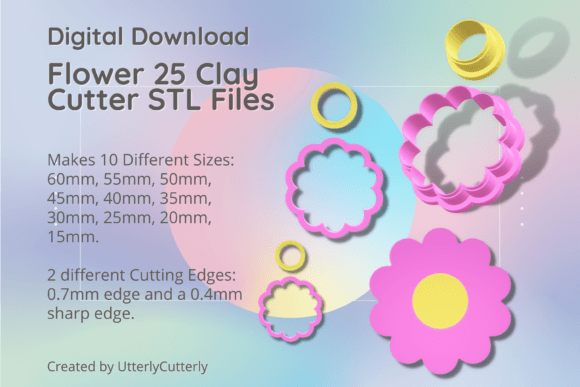
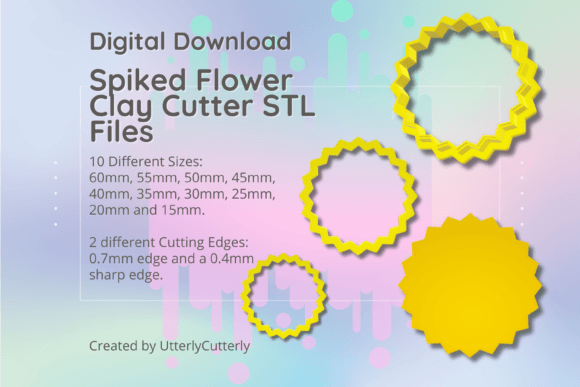
When evaluating the Spiked Flower Clay Cutter - STL Digital, it is necessary to look beyond the aesthetic design and examine the engineering parameters included in the download. This bundle is structured to offer versatility through size gradation and edge variation. The package contains ten sizes measured from the longest ends of the cutter: 60mm, 55mm, 50mm, 45mm, 40mm, 35mm, 30mm, 25mm, 20mm, and 15mm. This comprehensive range allows for the creation of cohesive sets, such as graduated jewelry components or tiered cookie decorations, without requiring multiple separate purchases.
Crucially, the bundle offers two distinct cutting edge types, each serving a different functional purpose. The first option features a 0.7mm wall thickness with a 3mm thick base and a 12mm height. This standard profile prioritizes durability and ease of printing. The second option, abbreviated as SE (Sharp Edge) in the file names, utilizes a 1mm support wall tapering to a 0.4mm cutting edge, maintaining the same 3mm base and 12mm height. Additionally, any embossing lines integrated into the design are set at 10.5mm tall, which dictates specific material thickness requirements for optimal results.
Evaluating Cutting Edge Profiles for Specific Applications
Selecting between the standard 0.7mm wall and the Sharp Edge (SE) variant is the primary decision point when using this Spiked Flower Clay Cutter - STL Digital. The choice should be driven by the material being cut and the desired finish rather than personal preference alone.
The Sharp Edge (0.4mm) is engineered for clean slicing through soft materials like polymer clay or fondant. A thinner cutting edge displaces less material during the incision, reducing distortion and drag. This results in crisp definition, which is particularly important for intricate spiked flower designs where detail loss can occur with thicker blades. However, the tradeoff is structural fragility. A 0.4mm edge is more susceptible to damage if printed with low infill, improper orientation, or if used with stiff, cold clay. It requires careful handling and precise printer calibration.
Conversely, the standard 0.7mm wall offers greater longevity and print reliability. While it may compress softer clays slightly more than the SE variant, it is significantly more robust. This profile is often preferable for users who are new to 3D printing cutters, those using abrasive clay bodies containing grog or sand, or makers who require tools that can withstand frequent washing and heavy use. For cookie dough, which is denser and stickier than polymer clay, the sturdier 0.7mm wall often provides a better balance of cutting ability and tool lifespan.
Material Compatibility and Embossing Considerations
The utility of the Spiked Flower Clay Cutter - STL Digital is heavily dependent on material preparation. The specification regarding embossing line height is a critical constraint. With embossing elements standing at 10.5mm tall, the cutter is designed to interact with clay sheets thicker than 1.5mm. Attempting to use this cutter on thin veneers or sheets rolled below this threshold will result in the embossing feature bottoming out against the work surface, potentially damaging both the clay piece and the printed cutter.
Users must also consider the shrinkage rate of their chosen medium. Because the cutter sizes are fixed digital dimensions, the final fired or baked size will differ from the cut size. Ceramic artists must account for clay body shrinkage percentages when selecting from the 15mm to 60mm range to ensure the finished piece meets project specifications. Polymer clay users generally experience minimal shrinkage, making the digital dimensions highly accurate for jewelry assembly planning.
3D Printing Requirements and Printability
A significant advantage of this digital bundle is its design for printability. However, "easily printed" is relative to the user's equipment and skill level. The 3mm thick base provides a stable foundation that aids bed adhesion and reduces warping during the print process. The 12mm height is manageable for most FDM printers without requiring extensive supports, provided the nozzle diameter and layer height are appropriate.
For the Sharp Edge variants, nozzle selection matters. A 0.4mm nozzle is typically the maximum recommended size for printing the 0.4mm cutting edge reliably; larger nozzles may not resolve the thin geometry accurately. Layer height also influences edge quality. Lower layer heights (0.12mm to 0.16mm) generally produce smoother cutting surfaces that require less post-processing. Users should anticipate some light sanding or blade finishing regardless of print settings, as layer lines on the cutting face can transfer texture to the clay.
Comparing Digital STL Bundles Versus Physical Cutters
Determining whether to acquire the Spiked Flower Clay Cutter - STL Digital or purchase physical alternatives involves weighing immediacy against customization. Physical metal or plastic cutters arrive ready to use with guaranteed consistency and durability. They eliminate the need for printer maintenance, filament costs, and post-processing labor. For high-volume commercial production where tool failure is not an option, physical brass or stainless steel cutters remain the industry standard.
The digital STL format excels in scenarios requiring flexibility and cost-efficiency. If a maker needs a specific size that falls between standard commercial offerings, or if they wish to test a new design before committing to expensive metal tooling, the digital route is superior. The ability to reprint a broken cutter instantly eliminates downtime. Furthermore, the cost-per-unit drops significantly after the initial file purchase, making it economically viable for hobbyists, small-batch sellers, and educators who need multiple sizes without a proportional increase in expense.
Integration with Existing Digital Libraries
This bundle is positioned as part of a broader ecosystem, with new STL files added weekly. When evaluating this purchase, consider how the spiked flower geometry complements existing assets. The standardized sizing increments (5mm steps) suggest compatibility with other modular designs from the same source. Makers curating a signature style benefit from this interoperability, as it allows for mixing and matching shapes while maintaining consistent scale relationships across different projects.
Ultimately, the Spiked Flower Clay Cutter - STL Digital serves as a functional component for makers equipped with 3D printing capabilities. It offers a practical solution for producing varied, detailed cuts across multiple scales. Success depends on matching the correct edge profile to the material, respecting the minimum thickness requirements for embossing, and applying appropriate printing parameters. For those willing to manage the fabrication process, it provides a versatile and economical alternative to traditional tooling.