Flower 28 Clay Cutter Hoop STL Digital Guide
For makers utilizing polymer clay, ceramic, or culinary mediums, the precision of your tools directly dictates the quality of your final product. The Flower 28 Clay Cutter - Hoop STL Digital provides a specialized solution for creators who own 3D printers and require consistent, scalable geometric forms. Unlike generic shapes found in standard libraries, this digital bundle focuses specifically on hoop-style floral designs that bridge the gap between delicate jewelry making and larger decorative applications. By downloading these STL files, you gain immediate access to a production-ready toolkit that eliminates shipping wait times and allows for on-demand manufacturing of custom cutters tailored to specific project requirements.
Selecting the Right Blade Profile for Your Medium
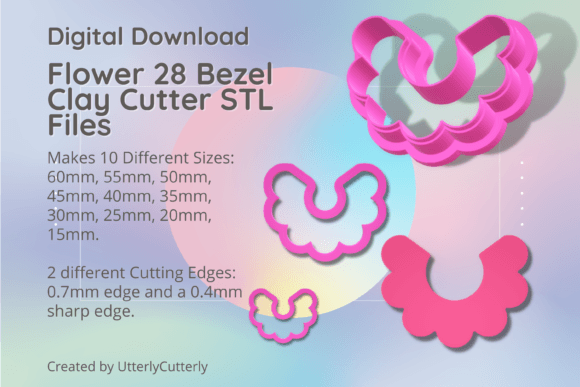
One of the most critical technical decisions when printing clay cutters is choosing the appropriate blade geometry. This digital pack includes two distinct cutting edge profiles designed to handle different material viscosities and finishing requirements. Understanding the difference between these two types ensures you do not waste filament or compromise the integrity of your workpiece.
The Standard 0.7mm Wall
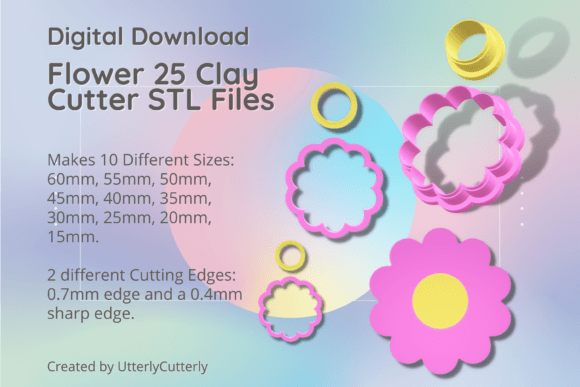
The standard cutter features a 0.7mm wall thickness with a robust 3mm thick base and a total height of 12mm. This profile is engineered for durability and ease of printing. It is the recommended choice for beginners in 3D printing or for those working with firmer clays that require more force to cut without bending the tool. The wider wall provides structural rigidity, making it less likely to warp during the printing process or deform under hand pressure. This version is ideal for cookie dough, fondant, and firm polymer clay where a clean cut is necessary but extreme sharpness is secondary to tool longevity.
The Sharp Edge (SE) Variant
Files abbreviated as "SE" in the download package represent the Sharp Edge variant. These cutters maintain the same 3mm base and 12mm height but utilize a 1mm support wall tapering to a precise 0.4mm cutting edge. This aggressive geometry is designed for soft polymer clay, precious metal clay (PMC), and detailed jewelry work where minimizing drag and distortion is paramount. The thinner edge slices through material rather than pushing it aside, resulting in cleaner lines that require less post-processing sanding. However, users should note that SE files may require slower print speeds and careful retraction settings to prevent nozzle clogging or layer shifting due to the fine detail.
Strategic Sizing for Jewelry and Culinary Applications
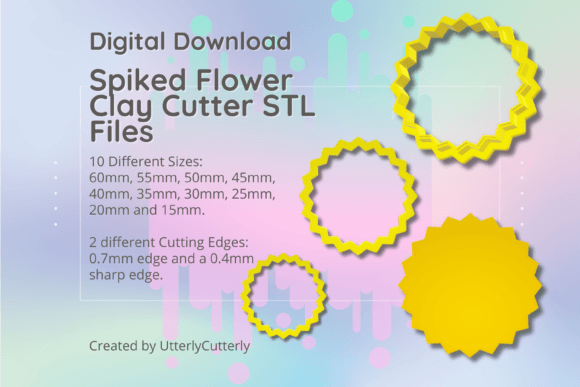
Versatility in design often comes down to having the correct scale for the intended application. A hoop flower design that looks elegant as a 60mm pendant may appear clumsy as an earring. This STL bundle addresses scaling challenges by providing ten incremental sizes: 60mm, 55mm, 50mm, 45mm, 40mm, 35mm, 30mm, 25mm, 20mm, and 15mm. All measurements are taken from the longest ends of the cutter to ensure accurate sizing relative to your workspace.
This graduated sizing system supports several practical workflows:
- Nesting Designs: Use multiple sizes within the same piece to create layered floral effects or concentric patterns in clay slabs.
- Product Line Consistency: Small business owners can offer the same hoop flower design across different product categories, using the 15mm-25mm range for stud earrings and the 40mm-60mm range for statement pendants or hair barrettes.
- Culinary Precision: Bakers can match cutter size to specific cookie dimensions or cake tier proportions without needing to resize files manually, which can sometimes distort complex curves.
Having these pre-sized files ready allows for rapid prototyping. You can test print a 20mm and a 30mm version in minutes to determine which scale best suits a new collection before committing to mass production.
Technical Considerations for Embossing and Print Success
While primarily designed as cutting tools, many users leverage these hoops for texture and depth. If the specific Flower 28 design iteration includes embossing lines, they are modeled at a height of 10.5mm. This specification is crucial for material preparation. To achieve a clear impression without bottoming out or tearing the clay, you must condition your material to a thickness greater than 1.5mm. Working with clay thinner than this threshold risks the embossing feature punching through the slab or creating uneven edges.
From a 3D printing perspective, the 12mm overall height of these cutters offers a balance between ergonomics and print efficiency. This height provides sufficient surface area for fingers to apply even downward pressure without discomfort, yet remains low enough to print quickly with minimal material usage. When slicing these files, consider using a brim for the larger 55mm and 60mm sizes to prevent bed adhesion issues, especially if printing the Sharp Edge variants. For the smaller sizes, a raft is generally unnecessary and may actually make cleanup more difficult. Always verify your printer’s minimum wall width capabilities; while most modern FDM printers handle 0.4mm walls reliably, older machines or those with worn nozzles may struggle with the SE files and should default to the 0.7mm standard versions.
Integrating Digital Assets into Creative Workflows
The primary advantage of acquiring the Flower 28 Clay Cutter - Hoop STL Digital over physical tools lies in workflow autonomy. For educators teaching ceramics or jewelry design, this means students can access identical tools instantly without budget constraints for bulk hardware purchases. For freelancers and content creators, it enables real-time responsiveness to trends; if hoop flowers become popular on social media, you can print and test new variations the same day rather than waiting weeks for international shipping.
Furthermore, digital ownership facilitates customization. While these files are ready-to-print, advanced users can import the STLs into CAD software to modify wall heights or combine the hoop flower with other elements from our expanding library. New STL files are added to the store weekly, encouraging a modular approach to tool building. By curating a personal library of compatible cutters, you develop a unique aesthetic signature that distinguishes your work from makers relying solely on mass-produced commercial cutters.
Important Usage and Safety Guidelines
It is essential to remember that this product is a digital download, not a physical item. Access to the files is granted immediately after payment confirmation. Users are responsible for ensuring their 3D printer is properly calibrated before attempting to print the Sharp Edge variants, as failed prints on fine details can be frustrating and wasteful.
Additionally, while PLA and PETG are common materials for these cutters, always verify food safety compliance if using them for cookies or fondant. Standard 3D printing filaments and brass nozzles are not inherently food-safe due to potential bacterial harboring in layer lines and heavy metal leaching. For culinary applications, use certified food-safe filament, coat finished cutters with food-grade epoxy, or dedicate specific cutters exclusively to non-edible crafts like polymer clay to avoid cross-contamination risks. By understanding both the creative potential and the technical responsibilities of digital fabrication, makers can fully leverage this hoop flower cutter bundle to enhance both their artistic output and operational efficiency.