Dagger Drop 3 Clay Cutter STL: Digital Precision
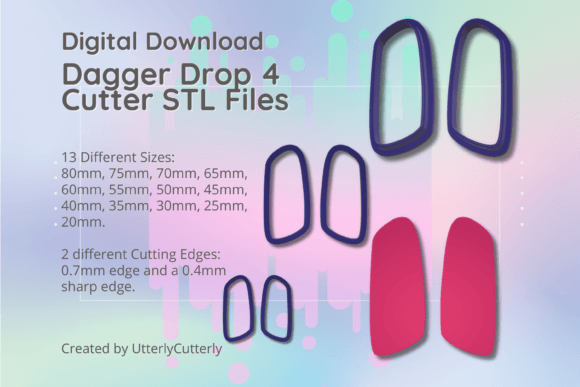
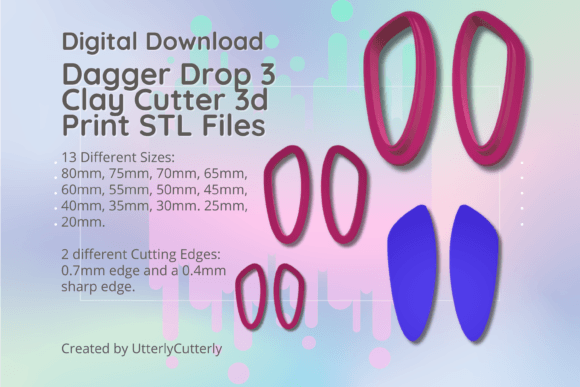
For polymer clay artists, cookie decorators, and small business owners, the transition from handmade shaping to precise digital fabrication marks a significant leap in production quality. The Dagger Drop 3 Clay Cutter - STL Digital provides this bridge by offering a comprehensive suite of printable files designed specifically for consistency and versatility. Rather than relying on generic shapes or waiting for physical shipping, creators can access a bundle of statement dagger drop cutters immediately after purchase. This digital download includes thirteen distinct sizes and two specialized cutting edge profiles, allowing users to curate custom tool sets that match their specific project requirements without unnecessary waste or delay.
Selecting the Right Edge Profile for Your Material
One of the most critical aspects of successful 3D printed cutter usage is matching the blade geometry to the material being worked. A cutter designed for soft cookie dough will often fail when used with firm polymer clay, and vice versa. The Dagger Drop 3 Clay Cutter - STL Digital addresses this by providing two distinct file variations within the same pack, ensuring optimal performance across different mediums.
The Standard 0.7mm Wall Configuration
The standard version features a 0.7mm wall thickness with a 3mm thick base and a total height of 12mm. This profile offers increased rigidity during the cutting process. When working with denser materials like ceramic clay or stiff polymer blends, a thinner blade can sometimes flex or warp under pressure, leading to distorted shapes. The 0.7mm wall provides the structural integrity needed to push through resistant materials while maintaining the intended silhouette. This option is generally recommended for users who prioritize durability and shape retention over an ultra-fine slice.
The Sharp Edge (SE) Variation
For projects requiring cleaner separation and less surface drag, the Sharp Edge files—abbreviated as SE in the download—are the superior choice. These files feature a 1mm support wall tapering down to a precise 0.4mm cutting edge. Like the standard version, they maintain a 3mm base and 12mm height for ergonomic handling. The reduced contact area at the cutting point minimizes friction, which is particularly beneficial when slicing soft clays or fondant where dragging can ruin the finish. Users should note that while the SE variant produces a sharper initial cut, the finer tip may require more careful post-processing and gentle handling during cleaning to prevent damage.
Strategic Sizing for Cohesive Collections
Versatility in design often comes down to scale. A single striking shape becomes a powerful branding element when available in multiple proportional sizes. This STL pack includes thirteen graduated dimensions measured from the longest ends: 80mm, 75mm, 70mm, 65mm, 60mm, 55mm, 50mm, 45mm, 40mm, 35mm, 30mm, 25mm, and 20mm. Having access to this full spectrum allows makers to build cohesive product lines rather than isolated pieces.
Consider a jewelry maker creating a dagger-themed collection. The 80mm size might serve as a bold pendant or statement brooch, while the 30mm or 25mm versions function perfectly as matching earrings. The 20mm size could be utilized for delicate charms or ring components. For bakers, this range supports tiered presentation; larger cookies can anchor a display while smaller versions fill gaps or serve as tasting portions. By downloading the complete set, creators avoid the inefficiency of purchasing individual sizes later and ensure that every piece in a series shares identical geometric proportions.
Embossing Depth and Material Thickness
Users intending to utilize the embossing features included in certain designs must plan their material preparation accordingly. Any embossing lines in these files are set to a height of 10.5mm. To achieve a clear impression without bottoming out or tearing the material, you must work with clay that is thicker than 1.5mm. Attempting to emboss into thinner sheets will result in poor definition and potential structural weakness. Always verify your slab thickness before beginning detailed impression work to ensure the digital specifications translate correctly to the physical object.
Optimizing Print Settings for Functional Tools
Because the Dagger Drop 3 Clay Cutter - STL Digital is a functional tool rather than a decorative model, print orientation and settings directly impact its lifespan and safety. While the files are designed to be easily printed, achieving professional results requires attention to slicer parameters.
- Orientation: Print cutters vertically with the cutting edge facing up. This ensures layer lines run parallel to the cutting direction rather than perpendicular, resulting in a smoother edge that requires less sanding.
- Infill: Use 100% infill or a high-density gyroid pattern. Hollow cutters can trap moisture and bacteria, making them unsuitable for food use and prone to cracking under hand pressure.
- Wall Count: Increase wall perimeters to at least three or four. This adds strength to the handle and base, compensating for any minor adhesion issues between layers.
- Material Safety: If using these cutters for food, verify that both your filament and printer nozzle are food-safe. Even then, many professionals recommend using 3D printed cutters primarily for polymer clay or as masters for silicone molding due to the microscopic layer lines inherent in FDM printing.
All cutters in this bundle are tested before being sold, but individual printer calibration varies. It is advisable to print a single test size first to confirm dimensional accuracy and edge quality before committing to the entire set.
Workflow Efficiency Through Digital Assets
The primary advantage of choosing an STL digital download over physical tools is the elimination of logistical friction. There is no shipping time, no risk of items breaking in transit, and no inventory storage required. Access to the files is granted immediately after payment, enabling rapid prototyping and just-in-time production.
This immediacy supports agile creative workflows. If a client requests a specific size variation for a custom order, you can assess whether it falls within the existing 20mm–80mm range and begin production within minutes. Furthermore, because new STL files are added to the store weekly, this pack serves as a foundation that can be expanded over time. Creators can mix and match the Dagger Drop 3 profile with other compatible designs to develop unique aesthetic signatures that distinguish their work in crowded marketplaces.
Understanding Limitations and Best Practices
While digital fabrication offers immense freedom, it also places quality control responsibilities on the user. The Dagger Drop 3 Clay Cutter - STL Digital is not a physical item; the final tool's performance depends entirely on your printer’s capabilities and your post-processing skills. Users with entry-level printers may need to spend additional time sanding the cutting edges to achieve smoothness comparable to commercial metal cutters.
Additionally, consider the wear characteristics of 3D printed plastics. Unlike steel, PLA and PETG will eventually dull with repeated use against abrasive materials like ceramic clay. Treat these as semi-consumable tools. Keep your original files backed up so you can reprint replacements as needed without repurchasing. For high-volume commercial production involving abrasive media, consider using these STLs to create master positives for casting durable metal or resin alternatives.
By understanding both the technical specifications and practical applications of these files, makers can leverage the Dagger Drop 3 Clay Cutter - STL Digital to enhance precision, streamline production, and expand their creative possibilities with confidence. Whether producing intricate jewelry components or themed confections, having the right digital assets ensures that execution matches vision every time.