Elevating Polymer Clay and Cookie Design with Celtic Knot Clay Cutter STL Digital Files
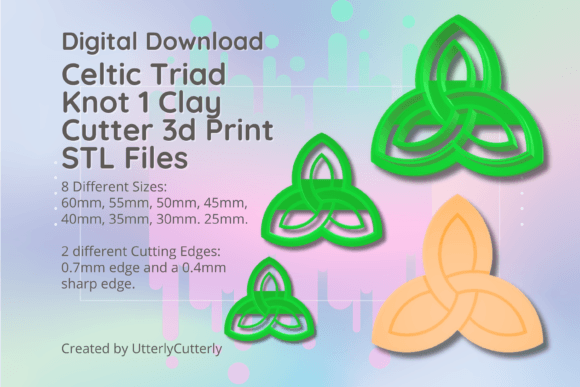
The intersection of traditional craftsmanship and modern additive manufacturing has fundamentally altered how creators approach surface design and structural form. For professionals in the polymer clay, jewelry making, and culinary arts sectors, the reliance on mass-produced, generic tools is rapidly being replaced by bespoke, digitally fabricated solutions. At the forefront of this shift is the Celtic Knot Clay Cutter - STL Digital Files, a resource that empowers makers to produce intricate, culturally resonant designs with precision and repeatability. This transition from physical inventory to digital assets represents more than just a change in procurement; it signifies a broader evolution in creative workflows where customization, speed, and technical specification are paramount.
The Convergence of Heritage Design and Digital Fabrication
Celtic knotwork is historically significant, representing eternity and interconnectedness through complex, continuous lines. Translating these organic, mathematical patterns into physical media has traditionally been a high-barrier skill requiring years of carving or molding expertise. The availability of a bundle of celtic knot cutters in a digital download STL file democratizes this aesthetic, allowing entrepreneurs and enthusiasts to integrate heritage motifs into contemporary products without the steep learning curve of hand-carving.
This relevance extends beyond mere aesthetics. In an industry saturated with uniform shapes, the ability to curate custom and unique cutter combos easily distinguishes a brand. Whether creating statement jewelry pieces or artisanal shortbread cookies, the specific geometry of Celtic knots offers a visual texture that catches light and glaze differently than standard geometric shapes. By utilizing 3D printing technology, creators can now access a library of designs that bridges ancient artistry with modern production efficiency, satisfying a consumer market that increasingly values products with narrative depth and handmade authenticity.
Technical Precision: Understanding Cutter Specifications
For professionals and serious hobbyists, the utility of an STL file lies entirely in its engineering. A poorly designed cutter results in torn clay, stuck dough, or excessive post-processing cleanup. Our cutters are designed to be easily printed because they adhere to strict tolerances optimized for FDM (Fused Deposition Modeling) printers. When evaluating the Celtic Knot Clay Cutter - STL Digital Files, understanding the distinction between the two included cutting edge profiles is essential for workflow optimization.
Dual-Edge Versatility for Diverse Applications
This digital pack includes two distinct cutter types, each serving a specific function in the creation process. Recognizing when to use each type is key to professional results:
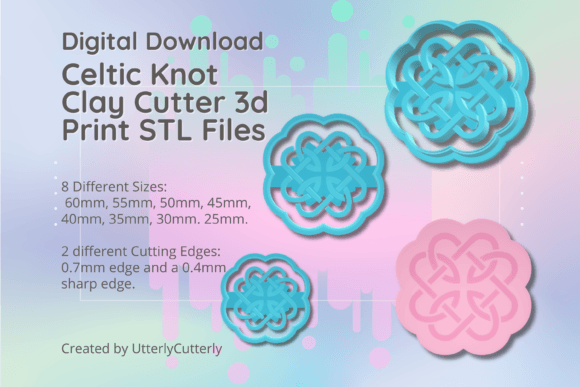
- Standard Edge (0.7mm Wall): Featuring a 0.7mm wall thickness, a 3mm thick base, and a height of 12mm, this cutter is the workhorse for general polymer clay and cookie work. The slightly thicker wall provides rigidity during the pressing motion, reducing deformation when working with stiffer clays or dense doughs. It offers a balance between sharpness and durability, making it ideal for high-volume production where tool longevity matters.
- Sharp Edge (SE): Abbreviated as SE in the file names, this variant features a 1mm support wall tapering to a precise 0.4mm cutting edge. With the same 3mm base and 12mm height specifications, the SE cutter is engineered for fine detail work. The reduced cutting edge minimizes drag and displacement, resulting in cleaner lines and less material waste. This profile is particularly critical for jewelry makers working with thin sheets of clay or bakers requiring crisp definition in delicate biscuit dough.
Both variations maintain a consistent 12mm height and 3mm reinforced base. This standardization ensures ergonomic handling and prevents the cutter from flexing under pressure, a common failure point in amateur-designed STL files. Furthermore, if there are any embossing lines integrated into the design, they are set at 10.5mm tall. This specific tolerance dictates that users should work on clay thicker than 1.5mm to ensure the embossing registers clearly without piercing through the material.
Scaling Creativity Through Size Variance
Versatility in design tools directly correlates to product range expansion. A single motif scaled across multiple dimensions allows creators to develop cohesive collections rather than isolated items. This pack provides eight different sizes, measured from the longest ends, facilitating everything from micro-jewelry components to large-scale decorative tiles.
The available sizes include:
- 60mm
- 55mm
- 50mm
- 45mm
- 40mm
- 35mm
- 30mm
- 25mm
This graduated sizing strategy supports current market trends toward modular design and personalization. A jewelry artist might use the 25mm and 30mm cutters for earring charms while utilizing the 50mm version for pendant bases. Similarly, a bakery can offer tiered pricing based on size or create nested packaging sets. Having immediate access to this full spectrum via digital download eliminates the lead times associated with sourcing physical molds, enabling rapid prototyping and responsive inventory management.
Adapting to Modern Creative Workflows
The shift toward digital assets like STL files reflects changing needs in the maker economy. Creators are no longer passive consumers of tools; they are active participants in their toolchain. This model supports a decentralized manufacturing approach where production happens on-demand, locally, and sustainably.
Sustainability and On-Demand Production
Traditional manufacturing involves shipping plastic goods globally, contributing to carbon footprints and packaging waste. By opting for a digital download, creators eliminate logistics emissions entirely. You print only what you need, when you need it. If a cutter breaks or wears out after months of commercial use, replacement is instantaneous and costs merely the price of filament. This aligns with the growing consumer preference for sustainable, low-waste business practices.
Continuous Innovation and Library Expansion
Static toolsets limit creative growth. Our ecosystem is built on continuous iteration, with new STL files coming to our store every week. This regular cadence ensures that your toolkit evolves alongside market trends and seasonal demands. For marketers and freelancers managing client projects, this means never having to say "no" due to tool limitations. The ability to mix and match new releases with existing Celtic knot designs fosters an environment of perpetual innovation, keeping product lines fresh and engaging.
Quality Assurance in Digital Manufacturing
A critical concern for professionals adopting digital fabrication is reliability. Unlike physical tools inspected before purchase, digital files require trust in the designer’s testing protocols. All our cutters are tested before being sold as part of our standard quality assurance process. This validation ensures that the 0.4mm Sharp Edges actually print cleanly on standard nozzle sizes and that the 12mm heights provide adequate leverage.
This testing phase bridges the gap between CAD modeling and real-world application. It accounts for variables such as layer adhesion, bridging capabilities, and material shrinkage. When you download these files, you are accessing a verified manufacturing blueprint rather than an experimental model. This reliability is essential for businesses where downtime equals lost revenue.
Integration and Practical Application
To maximize the value of this bundle, creators should view these cutters as part of a larger system. The standardized base thickness and height allow these Celtic knot cutters to be used interchangeably with other STL files in our catalog. This interoperability is vital for curating custom and unique cutter combos easily.
Consider the practical application in a mixed-media workflow: using the 40mm Sharp Edge cutter for a polymer clay base, then pairing it with a complementary texture stamp or a smaller accent cutter from a future release. This systematic approach to tool selection streamlines production and enhances design coherence. For cookie decorators, the consistent sizing allows for predictable baking times and uniform packaging, solving operational headaches often caused by inconsistent handmade tools.
The Future of Bespoke Tooling
The adoption of Celtic Knot Clay Cutter - STL Digital Files is indicative of a maturing maker market. We are moving past the novelty phase of 3D printing into an era of specialized, professional-grade digital tooling. As 3D printers become faster and materials more advanced, the fidelity of printed cutters will continue to improve, further blurring the line between digital design and physical craft.
For entrepreneurs, freelancers, and enthusiasts, embracing this technology is not just about acquiring a specific shape; it is about adopting a resilient, scalable, and innovative production methodology. It places the power of manufacturing directly in the hands of the creator, ensuring that artistic vision is never compromised by tool availability. By leveraging high-quality, tested STL files, you secure a competitive advantage rooted in both cultural appreciation and technological proficiency.
Please note: This is not a physical item. You will have access to download the files immediately after payment. Ensure your 3D printer is properly calibrated to achieve the specified 0.4mm and 0.7mm wall thicknesses for optimal performance.