Moroccan Donut Scallop Clay Cutter STL: Technical Specifications and Practical Application
The intersection of digital fabrication and traditional craft has created a demand for precision tools that bridge the gap between artistic vision and physical execution. The Moroccan Donut Scallop Clay Cutter STL represents a specific niche within this ecosystem, offering a digital asset designed for creators who require geometric consistency in polymer clay, ceramic, or culinary applications. Unlike generic shape cutters, this bundle focuses on the intricate interplay of scalloped edges and donut-style negative space, a combination that presents unique challenges in both 3D printing and material cutting. For professionals and serious hobbyists, evaluating this file set requires looking beyond the aesthetic to understand the engineering decisions regarding wall thickness, cutting edge profiles, and size gradation.
Design Architecture and Printability
The primary value proposition of any cutter STL is its printability. A poorly designed file results in failed prints, fragile tools, or rough edges that damage the workpiece. This Moroccan Donut Scallop bundle addresses these concerns through two distinct cutting edge configurations, acknowledging that different materials and printer setups require different geometries. Understanding the distinction between these two types is essential for maximizing the utility of the download.
Standard Wall Configuration
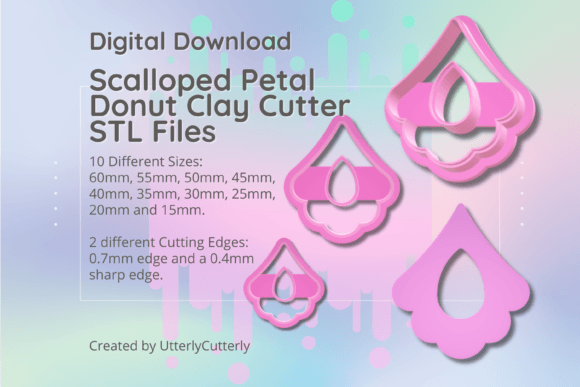
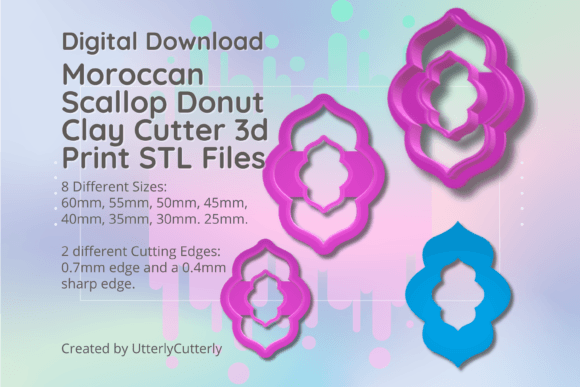
The first option features a 0.7mm wall with a 3mm thick base and a total height of 12mm. This specification strikes a balance between rigidity and material efficiency. The 0.7mm wall is generally safe for most FDM printers with standard 0.4mm nozzles, as it allows for two perimeters plus infill or three solid perimeters depending on slicer settings. The 3mm base provides necessary structural integrity, preventing the cutter from warping during the cooling phase of the print or flexing under hand pressure during use. This version is typically best suited for softer clays where extreme sharpness is less critical than tool durability.
Sharp Edge (SE) Variant
Labeled as "SE" in the file directory, the Sharp Edge variant utilizes a 1mm support wall tapering to a 0.4mm cutting edge. This design mimics the profile of professional metal cutters more closely than standard 3D printed alternatives. The 1mm support wall ensures the thin cutting edge does not collapse during printing, while the 0.4mm tip offers cleaner shearing action against firmer materials. Users should note that printing this variant successfully often requires optimized retraction settings and adequate part cooling to prevent blobbing at the thin edge. The trade-off for superior cutting performance is a slightly higher risk of print failure if machine calibration is suboptimal.
Dimensional Versatility and Workflow Integration
Professional workflows rarely rely on a single size. The inclusion of eight discrete sizes transforms this product from a simple shape generator into a scalable design system. The sizes range from 25mm to 60mm in 5mm increments (25mm, 30mm, 35mm, 40mm, 45mm, 50mm, 55mm, 60mm). It is important to clarify that these measurements refer to the longest ends of the cutter, ensuring accurate scaling when planning project dimensions.
This graduated sizing facilitates several practical applications:
- Nesting Designs: Creating concentric patterns in jewelry or decorative tiles by using multiple sizes in sequence.
- Product Line Consistency: Maintaining identical proportions across different product tiers, such as small stud earrings versus large statement pendants.
- Material Optimization: Selecting the precise size needed to minimize waste when working with expensive precious metal clays or limited-batch polymer blends.
- Culinary Scaling: Adapting the same visual motif for different serving contexts, from petit fours to full-sized cookies.
The ability to curate custom combinations is further enhanced by the weekly release schedule of new STL files mentioned by the provider. This suggests an expanding ecosystem where the Moroccan Donut Scallop cutters can be integrated with future releases, supporting long-term creative development rather than serving as a standalone novelty.
Embossing Compatibility and Material Constraints
A critical technical detail for users intending to combine cutting with surface texture is the embossing line height. The embossing elements in this file set stand 10.5mm tall. Given the overall cutter height of 12mm, this leaves only 1.5mm of clearance above the embossed feature. Consequently, these cutters are engineered for materials thicker than 1.5mm.
Attempting to use these cutters on thinner sheets will result in the embossing lines bottoming out before the cutting edge fully penetrates the material, leading to incomplete cuts and distorted textures. For polymer clay artists, this means conditioning clay to a consistent thickness greater than 1.5mm is a prerequisite. In ceramic applications, this specification aligns well with slab building techniques but may be unsuitable for delicate pinch pot walls. Recognizing this limitation prevents frustration and ensures the tool performs as intended within its operational parameters.
Quality Assurance and Digital Asset Reliability
In the marketplace of digital fabrication files, reliability is as important as geometry. The provider states that all cutters are tested before sale. For the end-user, this testing protocol translates to reduced trial-and-error time. Verified files typically indicate that overhang angles have been validated, bridging distances are within printable limits, and wall thicknesses correspond to actual nozzle capabilities rather than theoretical CAD dimensions.
However, users must remember that this is a digital download, not a physical item. Access is granted immediately after payment, placing the responsibility of manufacturing quality on the user’s equipment and settings. Success depends on proper printer calibration, appropriate material selection (PLA, PETG, or food-safe filaments for culinary use), and correct slicer configuration. The STL format itself is universally compatible, but achieving the specified 0.4mm sharp edge or clean 0.7mm walls requires a well-maintained machine.
Evaluating Fit for Professional and Creative Use
Determining whether the Moroccan Donut Scallop Clay Cutter STL fits your needs requires honest assessment of your workflow and equipment. This bundle offers significant value for specific user profiles while presenting limitations for others.
Ideal Candidates:
- Jewelry Makers: The size range and sharp edge option cater specifically to earring and pendant production where crisp definition matters.
- Polymer Clay Artists: Those working with slabs thicker than 1.5mm will benefit from the integrated embossing and cutting functionality.
- Bakers and Confectioners: Provided food-safe filament and hygiene protocols are observed, the scallop donut shape offers distinctive branding opportunities for cookie businesses.
- 3D Printing Enthusiasts: Users seeking functional prints that test and demonstrate printer precision will find the SE variant a useful benchmark.
Considerations for Other Users:
- Beginners with Uncalibrated Printers: The 0.4mm cutting edge may prove challenging without prior tuning experience; starting with the standard wall version is advisable.
- Thin-Sheet Crafters: If your primary medium is consistently under 1.5mm thick, the embossing feature will not function correctly, reducing the bundle’s effective utility.
- One-Time Users: While reasonably priced as a digital asset, those needing only a single cut might find purchasing a physical cutter more economical than investing in filament, print time, and post-processing.
Practical Recommendations for Implementation
To maximize return on this digital investment, consider the following operational guidelines. First, print one test cutter in each configuration before committing to a full set. Use the test print to verify dimensional accuracy and edge quality. Second, maintain organized file management; with eight sizes and two variants, clear labeling prevents workflow errors. Third, document your successful print settings for future reference, as environmental changes and filament batches can affect outcomes. Finally, engage with the provider’s broader catalog strategically; the weekly additions suggest planning purchases around complementary shapes can yield cohesive collections that enhance market appeal.
The Moroccan Donut Scallop Clay Cutter STL exemplifies how specialized digital tools can serve niche creative markets effectively. Its value lies not merely in the shape it produces, but in the thoughtful engineering that anticipates real-world printing constraints and material behaviors. For users whose requirements align with its specifications, it offers a reliable, versatile foundation for both artistic expression and commercial production.