Half Frill 3 Flower Clay Cutter STL Guide
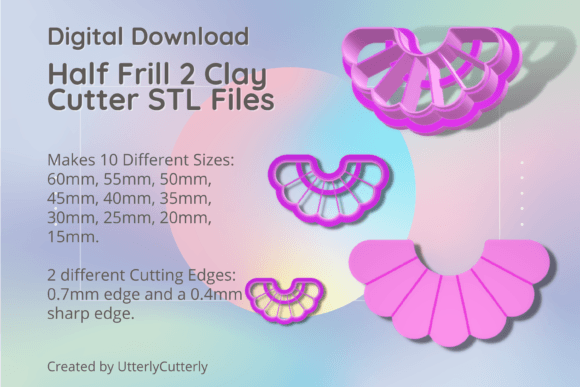
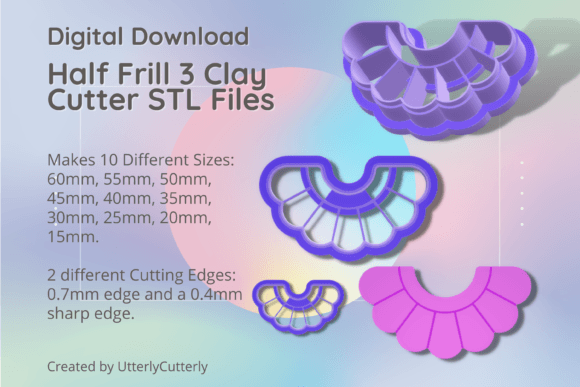
Achieving consistent, professional results in polymer clay jewelry or culinary arts often depends entirely on the quality of your tools. The Half Frill 3 Clay Cutter - Flower STL provides a digital solution for creators who own 3D printers and require specific, scalable designs without waiting for shipping. This digital bundle offers immediate access to ten distinct sizes and two specialized cutting edge profiles, allowing makers to produce everything from delicate earring components to substantial fondant decorations with precision. By utilizing these optimized STL files, you eliminate the guesswork associated with generic cutters and gain control over the exact dimensions and edge sharpness required for your specific medium.
Selecting the Correct Edge Profile for Your Medium
One of the most significant advantages of this digital pack is the inclusion of two distinct cutter types tailored for different materials. Understanding when to use each profile is essential for preventing material waste and ensuring clean cuts. The files are categorized to help you make this distinction easily during the printing process.
- 0.7mm Wall Cutters: These feature a 0.7mm wall thickness, a 3mm thick base, and a total height of 12mm. This profile is robust and durable, making it ideal for softer mediums like cookie dough, fondant, or gum paste. The thicker wall prevents the cutter from warping under pressure and provides a comfortable grip when working with edible materials that require more force to cut through.
- Sharp Edge (SE) Cutters: Abbreviated as SE in the file names, these possess a 1mm support wall with a precise 0.4mm cutting edge. Like the standard version, they have a 3mm base and 12mm height. This finer edge is specifically engineered for polymer clay and metal clay. The sharper profile slices through conditioned clay cleanly without dragging or distorting the frill details, which is critical for maintaining the definition of intricate floral patterns in jewelry making.
Choosing the correct file before printing saves filament and time. Using a Sharp Edge cutter on stiff cookie dough may result in blade damage, while using the 0.7mm wall on soft polymer clay can compress the design rather than slice it. Having both options in one download ensures you always have the appropriate tool geometry for the task at hand.
Scaling Designs Across Ten Precise Sizes
Versatility in size allows creators to build cohesive collections rather than isolated pieces. This bundle includes ten graduated sizes measured from the longest ends: 60mm, 55mm, 50mm, 45mm, 40mm, 35mm, 30mm, 25mm, 20mm, and 15mm. This comprehensive range supports various practical applications that single-size physical cutters cannot accommodate.
For jewelry designers, the smaller increments between 15mm and 30mm are invaluable for creating matching sets. You might use the 25mm cutter for stud earrings and the 40mm version for a coordinating pendant, ensuring the half-frill motif remains proportionally identical across different wearable formats. For bakers and cake decorators, the larger 50mm to 60mm options provide bold accents for tiered cakes or large-format cookies, while the mid-range sizes work perfectly for cupcake toppers or petit fours.
The ability to print these sizes on demand also solves storage issues. Instead of purchasing and storing twenty individual plastic cutters, you keep a single digital folder. If a client requests a custom size for a bridal shower favor or a specific earring drop length, you can select the exact file needed and print it within minutes. This responsiveness is a key benefit for small business owners managing custom orders.
Technical Considerations for Embossing and Print Quality
When working with detailed floral designs, understanding the Z-axis limitations of the STL file prevents frustration during the crafting phase. If your chosen Half Frill 3 Clay Cutter - Flower STL variant includes embossing lines, note that these features are 10.5mm tall. Consequently, you must condition your clay to be thicker than 1.5mm to fully utilize the embossing function without bottoming out.
If the clay is too thin, the embossing detail will push through to the back of the piece, ruining the finish. Always measure your rolled clay slab before cutting if you intend to use the textured version of the cutter. For users who prefer flat cuts without texture, the standard cutting rim still functions perfectly on thinner sheets, but the embossing capability is strictly dependent on adequate material depth.
Regarding printability, these files are designed with a 3mm thick base to ensure strong bed adhesion and structural integrity during the print. When slicing, ensure your layer height and nozzle diameter are compatible with the 0.4mm sharp edge. A 0.4mm nozzle is generally recommended for the SE files to accurately reproduce the fine cutting tip, whereas the 0.7mm wall files are more forgiving and can be printed with standard settings. Proper orientation and support settings should be verified in your slicer software to maintain the verticality of the frill details.
Integrating Digital Cutters into Creative Workflows
The transition from physical to digital tooling offers benefits beyond simple convenience. For educators and workshop leaders, having access to the Half Frill 3 Clay Cutter - Flower STL means every student can have identical tools without the logistical challenge of sourcing bulk inventory. You can print a class set overnight, replacing broken or lost items instantly. This reliability supports a smoother learning environment where technical issues do not interrupt creative instruction.
For entrepreneurs selling finished goods, the consistency provided by standardized STL files protects brand identity. Customers expect uniformity; a "Small" flower earring purchased today should match the pair bought six months ago. Because these files do not degrade or wear down like handmade wire cutters, the 100th print is dimensionally identical to the first. This repeatability reduces quality control rejection rates and streamlines production batching.
Furthermore, the digital nature of this product encourages experimentation. Since the cost per unit is merely the price of a few grams of filament, makers can test different sizes or edge types without financial risk. You might discover that the 35mm Sharp Edge creates a better silhouette for barrettes than the 40mm, or that the 0.7mm wall works surprisingly well for thick gingerbread. This low-barrier testing fosters innovation and helps refine product lines based on actual material performance rather than theoretical assumptions.
Important Usage and Compatibility Notes
While this digital download offers extensive utility, it is important to recognize its scope. This is strictly a digital product; no physical item will be shipped. Access to the files is granted immediately after payment, requiring users to have their own 3D printing hardware and basic slicing knowledge. Those without access to a printer should seek local maker spaces or printing services to utilize these files.
Additionally, while the cutters are designed for easy printing, success depends on proper machine calibration. Bed leveling and flow rate calibration are particularly important for the Sharp Edge variants to ensure the 0.4mm tip prints continuously without gaps. Users should also consider food safety protocols if using these cutters for edibles. Standard FDM 3D prints have layer lines that can harbor bacteria; therefore, any cutter used for food should be coated with a food-safe epoxy or used exclusively with a barrier film, regardless of the filament type used.
Finally, these files are part of a broader ecosystem. The sizing convention aligns with other STL files in the store, facilitating cross-compatibility. When curating unique cutter combos, verify that the measurement standard (longest end) matches your existing library to maintain proportional harmony in mixed-media projects. Regular updates to the store mean new complementary designs become available weekly, allowing your digital toolbox to evolve alongside your creative practice.